Archiv für den Monat: September 2026

Meta One turns Instagram post links into a paid feature

Instagram businesses can finally put clickable links directly into organic posts and Reels.

Just not very many of them.

Meta’s new Meta One subscription includes links in organic Instagram posts and Reels for creators and businesses on its Advanced plan, which starts at $49.99 per month in the US.

According to Social Media Today, Advanced subscribers can add links to four Instagram posts and four Reels each month.

So after years of Instagram making businesses send people to the bio, a Story or somewhere else entirely, links have arrived in regular posts.

On a quota.

Four posts, four Reels

The allowance increases on Meta One’s more expensive business plans.

Social Media Today reports that the $149-per-month Expert plan allows links in eight posts and eight Reels each month, while the $499 Max plan raises that to 12 of each.

Meta itself confirms that Advanced includes links in organic posts and Reels, although its main announcement does not spell out the monthly limits.

At the Advanced level, that means businesses have eight link-enabled Instagram placements each month.

If links were the only reason you subscribed, the $49.99 price would work out to about $6.25 per linked post or Reel. Of course, they are not. Meta One Advanced also includes Story scheduling up to 30 days ahead, exportable analytics, deeper audience insights, team access and additional business tools.

Still, it is an unusual way to introduce one of Instagram’s most requested features.

You can link out now. Just choose your moments.

Instagram becomes a little more useful for traffic

The change matters to publishers, ecommerce sites and marketers because Instagram has historically been awkward as a source of referral traffic.

A clickable link inside the content removes a step.

A publisher can link a Reel directly to an article. A retailer can send a product post to its product page. A marketer can send campaign content directly to a landing page instead of asking users to hunt through a profile.

Meta also says Advanced includes exportable analytics and deeper audience insights. Its announcement does not clearly explain, however, what reporting will be available specifically for clicks on these new links.

That will be worth watching. The links become considerably more useful if marketers can easily measure which posts are actually sending traffic.

Meta One is rolling out globally

Meta launched Meta One on September 15 with subscription plans for individuals, creators and businesses.

The company says the service is available globally, although plans, features, prices and availability can vary by region, app and account.

Pricing already differs outside the US. Meta’s European announcement, for example, lists Advanced from €54.99 per month, Expert from €169 and Max from €549.

Meta One contains more than 50 features across Instagram, Facebook, WhatsApp and Meta AI.

For businesses interested in getting traffic from Instagram, though, one of the most consequential changes is considerably less futuristic.

Instagram posts can finally contain links.

Four of them a month, anyway.

The post Meta One turns Instagram post links into a paid feature appeared first on Search Engine Watch.

Source:: searchenginewatch.com
Google ordered to let rivals into its ad-tech walled garden

Google gets to keep its ad-tech business. It just has to make considerably more of it work with everyone else.

A newly unsealed remedies ruling in the US Justice Department’s antitrust case requires Google to build integrations between AdX, DFP and Prebid, while also allowing AdX to send real-time bids into competing publisher ad servers.

For publishers, that is the part worth paying attention to.

Google currently combines its publisher ad server, commonly known as DFP, and the AdX advertising exchange inside Google Ad Manager. Prebid, meanwhile, is the widely used open-source framework behind much of header bidding.

The court essentially wants those systems to stop behaving like separate plumbing networks.

Google has to connect the pipes

Under the remedies, Google must create and support integrations between:

  • AdX and Prebid
  • DFP and Prebid
  • AdX and competing publisher ad servers

That last part matters.

A publisher using another ad server should be able to receive real-time bids from AdX without also having to use Google’s publisher ad server.

The Justice Department described the change as giving publishers access to AdX demand without forcing them to use both sides of Google’s stack.

Google must also make it easier for publishers to export data from DFP and AdX, including information that could help them move to another provider.

In other words, the walled garden can stay. It just needs more gates.

Google also loses some home-field advantage

The ruling goes beyond APIs.

Google’s AdWords demand will no longer be allowed to receive preferential treatment simply because it is bidding through Google’s own ad-tech products.

AdWords also cannot bid directly into DFP under the remedies.

That addresses one of the central problems in the case: Google operating several important parts of the advertising auction while those parts had unusually good access to each other.

Google does not have to sell AdX, which was the more drastic remedy sought by the Justice Department. The court instead decided that interoperability rules and other behavioral restrictions were sufficient.

Don’t expect the switch to flip tomorrow

There is one fairly large catch.

Publishers are unlikely to see these changes immediately.

Google has around 12 months to open AdX to rival publisher ad servers, while the integrations connecting AdX and DFP with Prebid are expected to take roughly 12 to 15 months, according to the implementation timetable reported by Digiday.

So this is less “Google’s ad stack opens today” and more “Google has been told where to put the doors.”

A technical monitor and committee will oversee Google’s compliance for six years.

Whether publishers actually switch ad servers, gain more bargaining power or make more money as a result is another question.

The ruling does not guarantee any of those things.

What it does change is something much more basic: publishers should eventually be able to reach important Google advertising demand without needing quite so much Google machinery surrounding it.

For an industry that has spent years talking about Google’s walled garden, that is a fairly literal remedy.

The post Google ordered to let rivals into its ad-tech walled garden appeared first on Search Engine Watch.

Source:: searchenginewatch.com
Perplexity is betting on creators as AI search’s new distribution layer

Perplexity is expanding its use of creators as it looks to promote products such as Perplexity Computer and drive more measurable results from influencer marketing.

According to Digiday, the company recently hired for a Creator & Influencer Marketing Lead who would oversee campaigns involving more than 100 creators and multimillion-dollar budgets.

The role covers platforms including YouTube, LinkedIn, Instagram and X, and includes working with creators on original projects built with Perplexity Computer.

Perplexity is also looking beyond basic reach metrics. The job description says the program should be tied to engagement and conversions rather than impressions alone.

That is where the strategy starts to become more relevant to search marketers.

Creator content is increasingly showing up as a source inside AI search engines. YouTube videos, reviews, Reddit discussions and other third-party content can all be retrieved and cited in AI-generated answers.

An analysis of Perplexity’s retrieval system published earlier this year found YouTube appearing frequently for some product and how-to searches. The sample was limited, so it should not be treated as a broad ranking study, but it showed that creator videos can be used directly as sources inside Perplexity answers.

Other brands are already paying attention to this overlap.

Zoom has used creator partnerships as part of its effort to improve how the company appears in AI search, while agencies have started looking at whether creators and their content are being cited by AI platforms.

For SEO teams, that adds another consideration when working with creators.

A creator may not only deliver views and clicks. Their content can also become another third-party source that search engines and AI systems use when answering questions about a product or brand.

There is no indication that Perplexity’s creator program is designed specifically to influence its own search results, and there is no evidence that sponsored creator content receives preferential treatment.

But the timing is notable.

Perplexity is increasing its investment in creator content just as creators are becoming a more visible source of information inside AI search.

That makes creator marketing increasingly relevant to SEO, particularly for brands trying to build visibility beyond their own websites.

The post Perplexity is betting on creators as AI search’s new distribution layer appeared first on Search Engine Watch.

Source:: searchenginewatch.com

Google Homepage tests new hover animation on + icon

Google homepage is testing a new hover animation. Previously, hovering over the “+” icon didn’t trigger anything special, but recently, hovering over it shows a new animation.

This isn’t a major change, but it’s worth sharing with the marketing community as another small example of how Google continues to refine its homepage design.

Here is a video of this.

Have you seen this animation on your own Google homepage?

The post Google Homepage tests new hover animation on + icon appeared first on Search Engine Watch.

Source:: searchenginewatch.com

Google tests URL breadcrumbs for sitelinks in sponsored ads

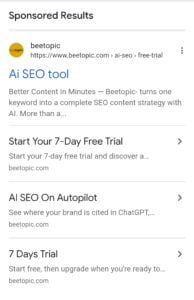
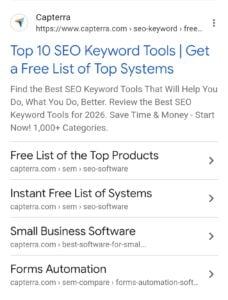
URL breadcrumbs for sitelinks

Google is now testing URL breadcrumbs shown alongside sitelinks within sponsored ads on mobile. I spotted this today clicking a sitelink redirects to its specific page, with the URL.

We’ve covered several recent changes to Google’s sponsored ad, including AI-generated review summaries and larger sitelink designs, but this breadcrumb addition is something new and different.

Here is a screenshot of how it looks.

URL breadcrumbs for sitelinks

I’m not entirely sure how useful showing URL breadcrumbs for sitelinks will be in practice, but from a design perspective, this update looks like a clean addition.

The post Google tests URL breadcrumbs for sitelinks in sponsored ads appeared first on Search Engine Watch.

Source:: searchenginewatch.com