Archiv für den Monat: Oktober 2026

Bing sponsored ads now showing more images within the ad unit

Bing sponsored ads now showing more images

Bing sponsored ads are now showing more images within the ad unit. We previously covered Bing testing large images for ads on mobile, and now it looks like Bing is testing additional images shown below the ad description as well.

Here is a screenshot of this.

Showing more images below the description is a solid test from Bing, since it gives users more visual context and could increase the likelihood of them clicking on the ad.

The post Bing sponsored ads now showing more images within the ad unit appeared first on Search Engine Watch.

Source:: searchenginewatch.com

5 best AI visibility webinars to watch in 2026-2027

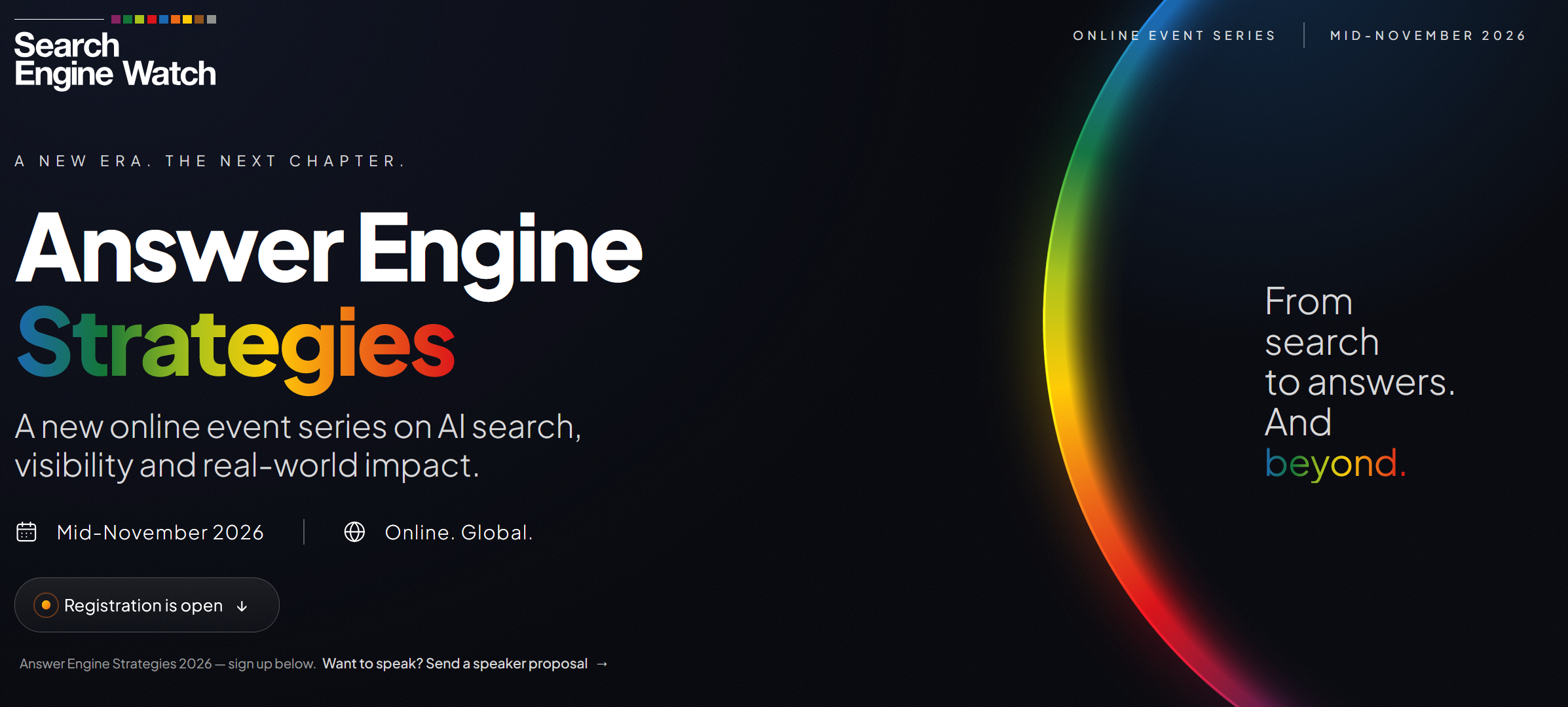
Answer Engine Strategies leads this list: it is Search Engine Watch’s own forthcoming free event, and I’m SEW’s publisher. It is planned for mid-November 2026, with speakers still to be announced. For a session available on demand, HubSpot offers a 30-day action plan for answer engine optimization (AEO).

Running publishing websites makes me especially interested in advice that changes what we publish or how we measure it. I’ve picked the other sessions around those jobs. There is a different recommendation here for a content editor, a technical SEO and someone trying to explain AI visibility to their boss.

Webinar or series Choose it for Access as of October 3, 2026
1. Answer Engine Strategies, SEW Our forthcoming event on practical AI search work Free; registration open; planned for mid-November
2. Winning AI Visibility, HubSpot Building a first action plan Advertised on demand
3. Attribution in the AI Era, IAB Interpreting claims about AI-influenced purchases Live; November 13, 1–2 p.m. EST; registration
4. Winning the AI Answer, Conductor Connecting customer questions, content and outside sources On demand
5. Optimizing for AI Agents, BrightEdge Investigating crawl access and technical barriers On demand; originally April 15; access form

1. Answer Engine Strategies: SEW’s forthcoming free event

Choose this for: our planned live discussions about practical AI search work.

Answer Engine Strategies is the event we’re developing at Search Engine Watch. The registration page currently lists a free, global online event for mid-November 2026. An exact day, full agenda and speaker lineup are still to be announced.

In my announcement of the series, I explained what I want speakers to bring: a case they can unpack, the work they did and the evidence behind what they learned. That might be a useful result, an experiment that changed their approach or a problem they still haven’t fully explained.

We’re also committing to educational sessions without sales pitches. For now, register if you want to follow its development and receive the joining details; choose one of the replays below if you need a session today.

2. HubSpot: Winning AI Visibility

Choose this for: turning an introduction to AEO into a first month of work.

Winning AI Visibility: An AEO Masterclass for Showing up on ChatGPT, Gemini and Perplexity is offered on demand with Aja Frost, HubSpot’s senior director of global growth and paid advertising.

The agenda connects an explanation of AI discovery with seven strategies and a 30-day action plan. That makes it the closest fit here for a marketer who needs to decide where to begin and give the work a schedule.

I’d bring a small set of questions customers actually ask before buying. For a software business, that could include which plan suits a five-person team, whether a particular integration is supported and how much an upgrade costs. As you watch, identify the pages that answer those questions and write down the first change you could make to each.

HubSpot draws on its own research, and the programme covers several aspects of AEO. For a specific crawl-access problem, BrightEdge’s technical session is a closer fit.

3. IAB: Attribution in the AI Era

Choose this for: understanding what a claim about AI-influenced purchases actually measures.

The Interactive Advertising Bureau (IAB) lists Attribution in the AI Era as an online webinar for November 13, 2026, from 1–2 p.m. EST. Its agenda extends IAB’s earlier visibility measurement framework into conversions and commerce.

Caroline Giegerich, IAB’s vice president of AI, hosts a discussion with Bluefish co-founder Jing Feng and Prudential Financial’s Ross Bucholc. This brings an association, a commercial platform and an advertiser into the conversation.

I’d bring a conversion report and ask how each AI-related claim was established. A logged referral, a customer saying they used AI search and a model assigning credit give you different evidence. Write down which your report contains and which it leaves uncertain.

The event page offers non-member registration but does not state a fee. Check the registration terms before committing.

4. Conductor: Winning the AI Answer

Choose this for: planning work across your own pages and the outside sources that discuss your brand.

Winning the AI Answer: High-Impact AEO Strategies is available on demand from Conductor. The session features Pat Reinhart alongside Graphite’s Ethan Smith and Marcos Ciarrocchi.

The agenda covers finding questions in customer conversations, communities and support data, then connecting those questions to content on your website and authority across external sources. It also includes measurement frequency and the metrics to prioritize.

I’d choose it when the work needs to involve content, customer support and communications. Bring a relevant AI answer and open its cited pages. Separate the sources you control from reviews, publications or community discussions, then note where your product is described incompletely or inaccurately.

5. BrightEdge: Optimizing for AI Agents

Choose this for: checking whether technical access problems are interrupting discovery.

Optimizing for AI Agents: What Marketers Need to Know About Crawl Behavior is an on-demand BrightEdge session originally presented on April 15, 2026. Dave McAnally and Elizabeth Humburg are the featured speakers.

The agenda deals with different types of AI agents, crawl access, technical readiness and content structure.

Take a priority URL and ask your technical team what a relevant crawler receives: whether the request succeeds, whether a security rule challenges it and whether the response contains the text you expect. Check the purpose of each agent against your existing permissions policy before changing access settings.

The recording is accessed through a form. It dates from April, so check current crawler documentation before implementing a specific directive discussed in the session.

What to bring to the webinar you choose

Your immediate task Session Bring this Work on afterwards
Start an AEO plan HubSpot Customer buying questions A first month of page changes
Assess attribution claims IAB, November 13 A conversion report Clearer evidence behind AI-related claims
Review outside sources Conductor An AI answer and its cited pages A source list for content and communications
Investigate crawl access BrightEdge A priority URL and technical findings Specific access or response issues to resolve

When reviewing the work, keep the original customer questions and the changes you made beside your results. That is the publisher’s question I raised in my piece on what AI visibility tools are measuring: I want to see which questions a score represents before deciding where to put the budget.

For live discussion as our programme develops, register for Answer Engine Strategies. We will announce the speakers and full event details on the event page.

The post 5 best AI visibility webinars to watch in 2026-2027 appeared first on Search Engine Watch.

Source:: searchenginewatch.com

Best AI visibility conferences and summits in 2026–2027

Answer Engine Strategies (AES), the free online series we’re building at Search Engine Watch, is our first pick for readers who want to follow practical AI search work without a travel budget. For an in-person conference with a detailed AI visibility programme available now, I’d look at the ones below.

Disclosure: SEW organizes AES and has placed it first. Its first edition is planned for end of October 2026; the exact day and speakers are still to be announced. The other events are grouped by what their programmes can help you do. It’s the single free one, and it’ll be ongoing, as well.

Event Next edition or editions Format and access Published cost Why consider it?
Answer Engine Strategies Mid-November 2026; exact day TBA Online series; registration open Free SEW’s developing programme of practical AI search cases
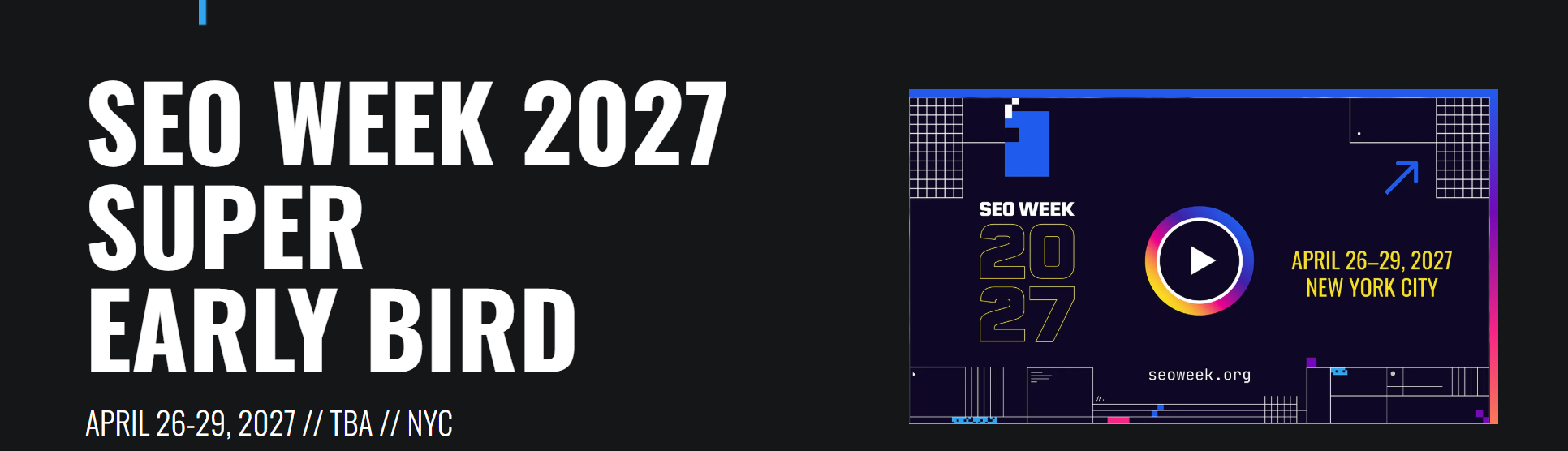
SEO Week 26–29 April 2027; New York In person; venue TBA Paid; see ticket portal Technical AI search; assess the 2027 programme when published
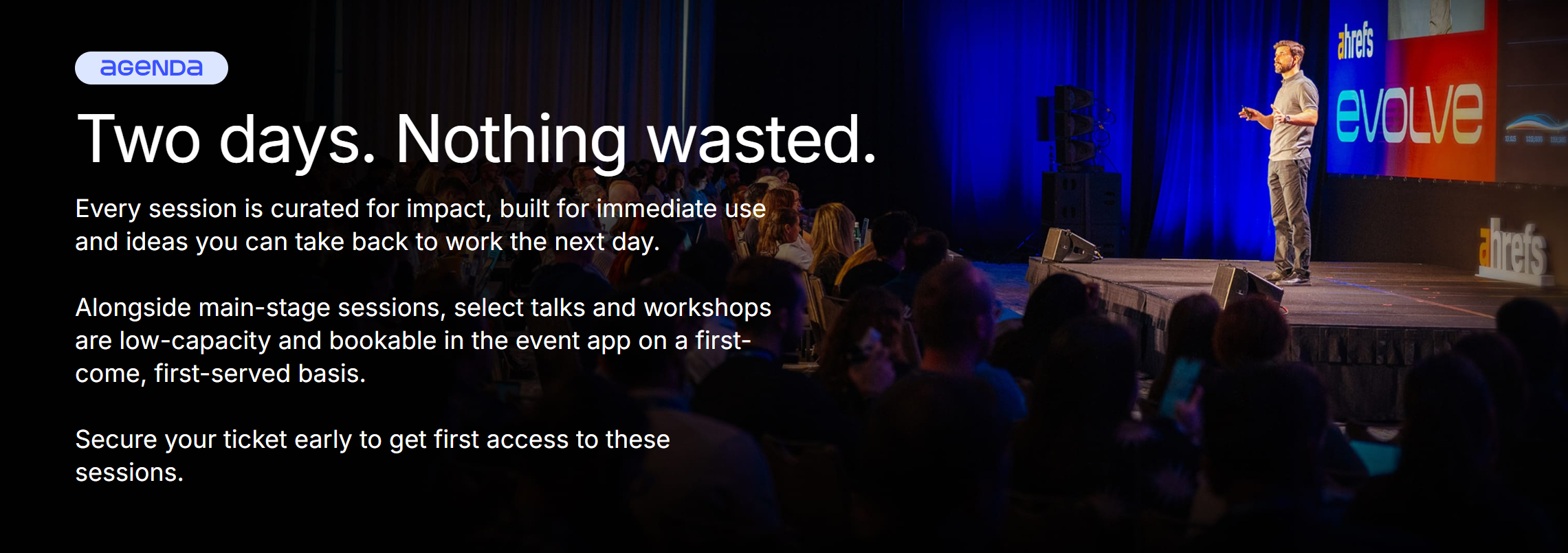
Ahrefs Evolve 12–13 October 2026; San Diego. 14–15 April 2027; Singapore San Diego tickets; Singapore waitlist San Diego Standard: $1,299 + 7.75% tax. Singapore: TBA Ecommerce, cited content and the wider marketing operation
AI SEO & GEO Online Summit 7 October 2026 Online; two hours, with live Q&A Free A short introduction to brand and local AI visibility experiments
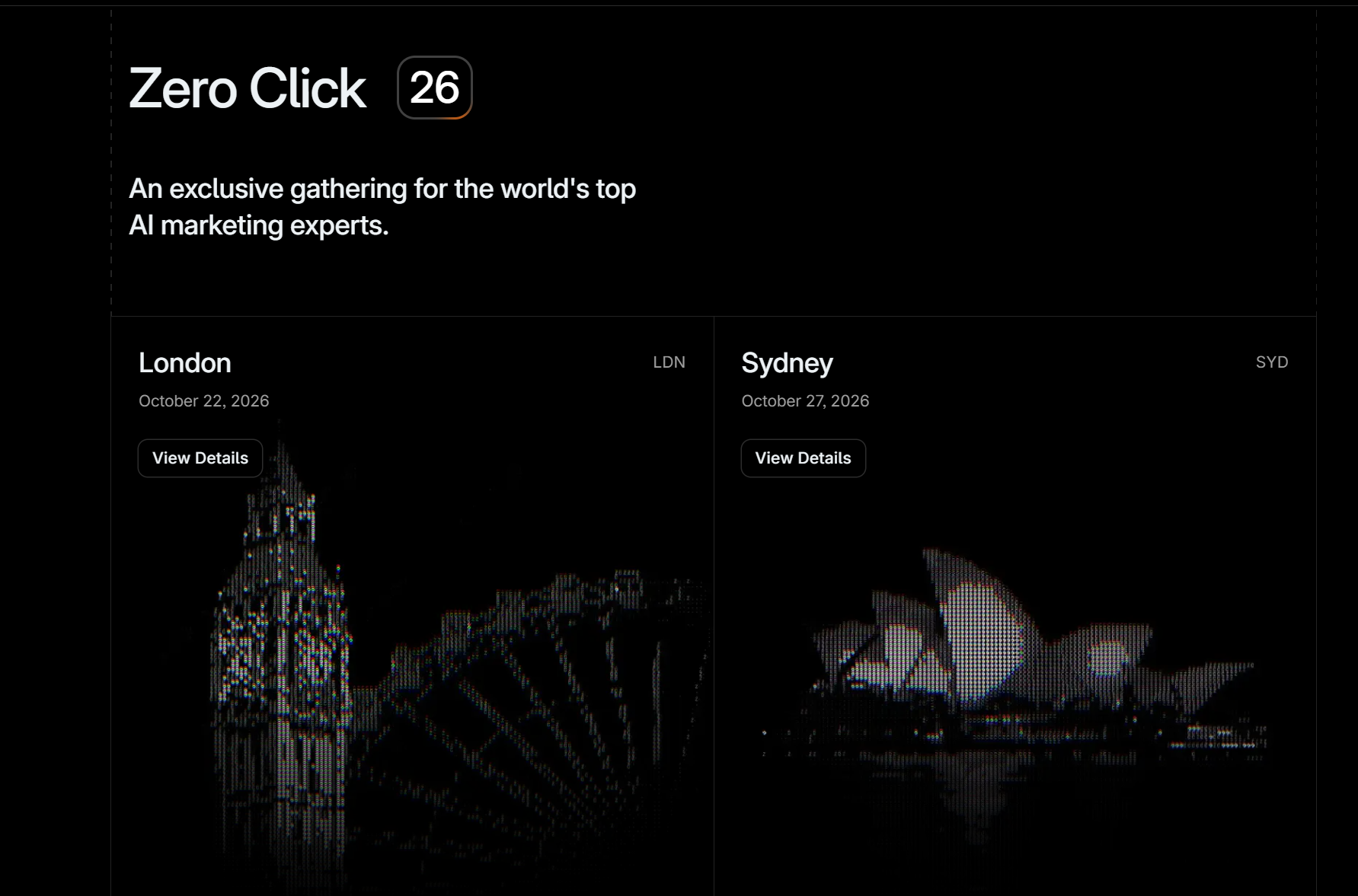
Zero Click by Profound 22 October: London. 27 October: Sydney. 29 October: Singapore, all 2026 In person; request a place Free; places limited Brand and agency perspectives within Profound’s community
SEO & GEO Summit 15–16 October 2026; Disneyland Paris In person; French programme Price grid: €250/day or €500/two days, excl. VAT; promotional banner differs AI visibility alongside the broader acquisition programme

Details checked on 3 October 2026. Prices are organizer-published, without travel or accommodation; tax is shown where specified. Programme recommendations come from published session descriptions, not a claim that I’ve attended every event.

As SEW’s publisher, I want these events to help us decide what to change on a real website and how to judge the result. I’ve looked for sessions that explain source selection, brand accuracy, measurement or implementation. That gives a small-business marketer a different shortlist from a search lead who has to coordinate developers, content teams and reporting.

Answer Engine Strategies: SEW’s free online series

When: mid-November 2026, exact date TBA. Where: online. Cost: free.

Answer Engine Strategies is the event series we’re developing around AI search, visibility and what those changes deliver for businesses. Our first edition is open for registration, with the speakers and full programme still to come.

The intention is to bring practitioners‘ work into the discussion: what they changed, the evidence they gathered and the decisions that followed. I want cases where a result challenged an assumption as much as cases that went neatly to plan. We’ve explained that thinking in our introduction to Answer Engine Strategies.

We’re keeping attendance free and the sessions educational, with no sales pitches. SEW’s published commitment also says attendee contact details won’t be passed to speakers or sponsors.

AES belongs on the list for readers who want to join that work as it develops. It’s an online series, and its recommendation here rests on the programme we’re building. The published agendas below give you more detail to assess today.

Register for Answer Engine Strategies →

SEO Week: a 2027 option for technical search teams

When: 26–29 April 2027. Where: New York City; venue TBA. Access: super early-bird sales page available; check the ticket portal for the current price.

SEO Week has announced its 2027 dates, which makes it a concrete option for next year’s calendar. The reason to consider it for AI visibility is the depth of its previous programme.

The 2026 agenda included Microsoft’s Krishna Madhavan on how content moves through AI discovery systems, Jeff Coyle on retrieval and source selection, and Dale Bertrand on connecting search investment to financial impact. That mix gives technical search leads and marketing managers different ways into the same business problem.

For a team asking why its pages are accessible but rarely cited, the retrieval sessions are the relevant part. For someone who has to explain investment to a finance director, the measurement and budgeting sessions matter more.

The 2027 speaker lineup and session details remain to be assessed. Treat the 2026 programme as evidence of the event’s direction, and use the new programme and current ticket offer to make the purchase decision.

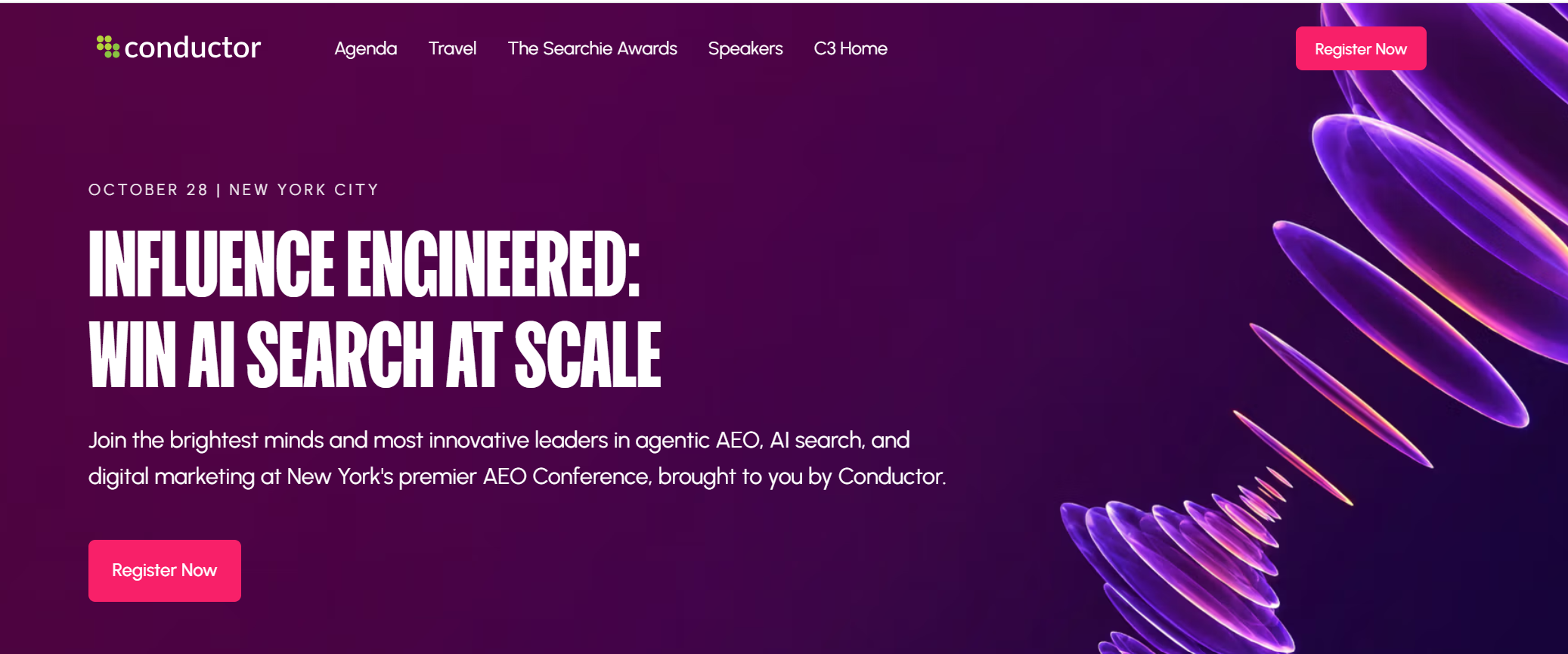
Conductor C3: building an enterprise AEO operation

When: 28 October 2026. Where: Convene One Liberty Plaza, New York. Cost: the organizer’s FAQ lists $500; confirm current registration availability.

C3 is the most relevant choice here when AI visibility has become a company programme with several teams, budgets and systems attached.

Its published agenda covers technical foundations for AI crawlers, an AEO maturity model and building a prompt index in production. A prompt index is a set of questions you track to understand how answer systems describe your category and brand. Maintaining one across markets and teams is a different job from checking a handful of prompts before a presentation.

That operational emphasis makes C3 a better fit for an enterprise search lead than for a beginner looking for a general introduction. Conductor runs the event, so expect its approach to the work to shape the programme. The FAQ explicitly welcomes attendees who aren’t customers.

One booking detail needs care: the FAQ quotes $500, while the price tiles mark their dated sales windows expired. The registration form remains on the page. Check the available tier before arranging travel; onsite ticket sales aren’t offered.

Ahrefs Evolve: AI visibility within the wider marketing job

When: 12–13 October 2026 in San Diego; 14–15 April 2027 in Singapore. Cost: San Diego Standard is listed at $1,299 before 7.75% tax. Singapore has a waitlist.

Ahrefs Evolve’s San Diego agenda connects AI visibility to work a marketing team already owns. Aleyda Solis has an ecommerce session covering AI search and agentic commerce; another session addresses the on-page content that gets cited.

For an ecommerce team, that combination is useful. A brand can need better product discovery, clearer supporting content and a way to connect answer visibility to revenue. Evolve puts those questions into a wider SEO and marketing programme, with Ahrefs product sessions also on the agenda.

Check the pass comparison if you plan to share sessions with colleagues afterwards. Recordings and slides appear as All-access benefits. That pass is currently listed at $2,199 before tax, so the cheaper Standard ticket should be assessed on its own inclusions.

The Singapore edition has confirmed 14–15 April 2027 at Pan Pacific Orchard, with a waitlist for ticket updates. The page’s programme highlights describe 2026; they aren’t the 2027 agenda.

AI SEO & GEO Online Summit: a two-hour, free introduction

When: 7 October 2026, 9–11 a.m. Mountain Time. Where: online, streaming on YouTube. Cost: free.

Chris Raulf’s AI SEO & GEO Online Summit is a manageable commitment for someone who wants to see concrete examples before choosing a larger conference.

The announced sessions include SE Ranking’s experiment tracking how a newly created brand surfaces across answer systems, a Duda presentation about local-business AI visibility, and a content strategy and production session from Boulder SEO Marketing. Live Q&A and future recordings are part of the published format.

A small-business marketer can use that programme to investigate two specific questions: how a brand with little existing reputation starts appearing, and what local businesses should examine on their websites. The studies and results still need to be judged through the methods the speakers present.

The two-hour format leaves less time for workshops or conversations between attendees. It’s a free learning option for a global audience, particularly if you can attend with a current project in mind and ask about it during Q&A.

Zero Click by Profound: free, in-person brand and agency sessions

When: London, 22 October; Sydney, 27 October; Singapore, 29 October 2026. Cost: free, with limited places allocated through a request form.

Zero Click’s remaining 2026 tour gives marketers in three regions an in-person AI search event without a ticket charge.

The London lineup includes senior marketers from Estée Lauder, De Beers and Nestlé, alongside Sky’s head of SEO and GEO and Anthropic’s head of Applied AI for EMEA. That breadth makes it especially relevant when brand, communications and search teams need a shared discussion about AI discovery.

Profound hosts the series and describes research and customer playbooks as part of the experience. It’s a chance to understand how that community approaches the work, with the host’s commercial perspective visible.

Request a place before booking travel. London’s page publishes the day’s outline but says the detailed agenda will be updated. The events are in person; available recordings are due through Zero Click Unlocked, with release dates to be checked separately.

SEO & GEO Summit: a French programme spanning search and acquisition

When: 15–16 October 2026. Where: Disneyland Paris. Language: French. Cost: the price grid lists €250 for one day or €500 for two, excluding VAT.

The SEO & GEO Summit is worth considering for French-speaking teams whose AI visibility work sits inside a broader acquisition plan.

Its provisional programme includes a client case comparing how AI describes a brand before and after changes, an investigation into why AI recommends a competitor, and a session on local visibility. Elsewhere, it covers paid search, social advertising, content, automation and CRM.

That wider mix suits a marketing manager coordinating several channels. A specialist looking for two full days devoted to AI retrieval will need to pick carefully across the parallel sessions.

The organizer says the final programme and session order will be set shortly before the event. Its promotional banner also advertises €225 excluding VAT while the one-day price grid says €250. Check the selected day and applied offer in the booking flow; we’ve used the explicit price grid in the comparison above.

For a wider search-marketing trip, our guide to the best SEO conferences covers the broader calendar. For the free online series we’re building, register for Answer Engine Strategies and we’ll send the joining details as the first edition takes shape.

The post Best AI visibility conferences and summits in 2026–2027 appeared first on Search Engine Watch.

Source:: searchenginewatch.com

What are AI citations? Who gets the credit when AI answers?

With Seymour, SEW’s AI learning companion.

AI citations are references an AI answer provides to identify its sources. In AI search, they usually appear as clickable numbers, links or source cards. Click one and you can open a page associated with the answer, see who published it and check the information for yourself.

For a website owner, a citation is also a possible route to a new reader. Your page might supply a detail in someone’s answer, and its source link gives that person a way to visit you.

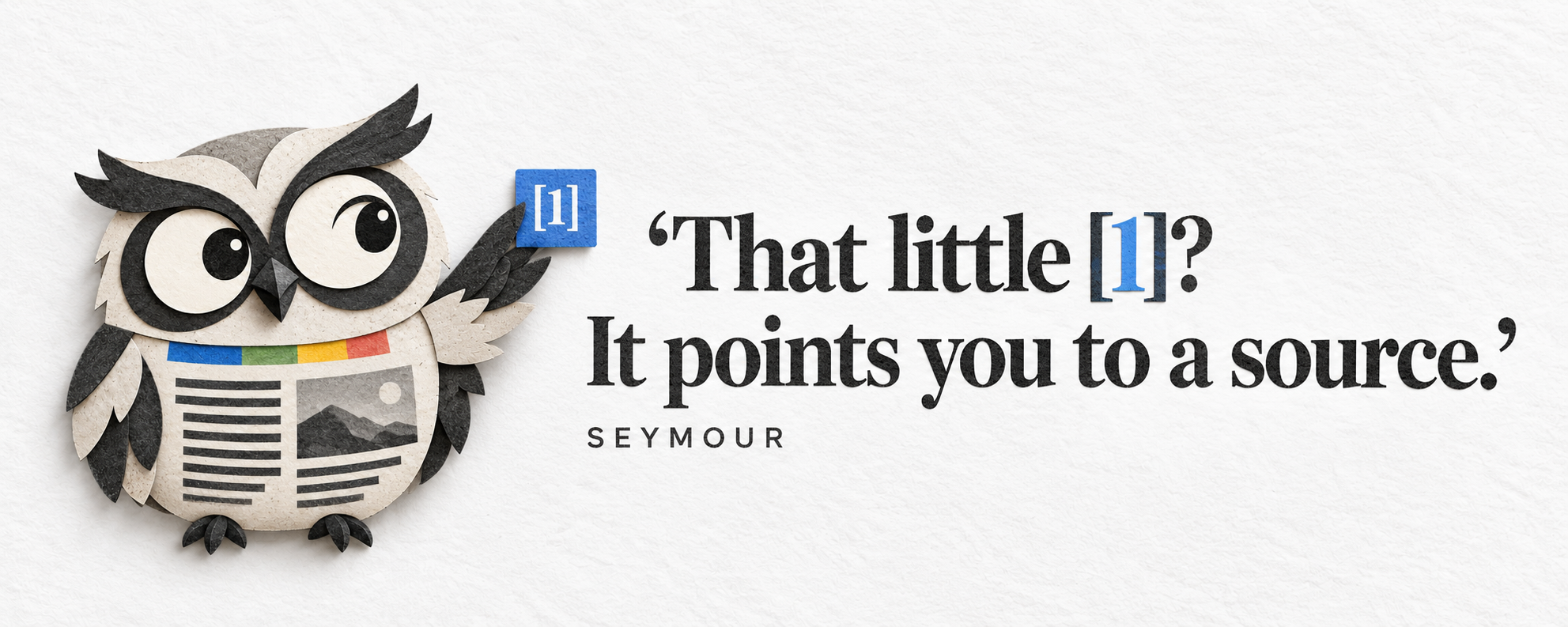
Picture an answer about email software. Beside a sentence about a free plan, there’s a small [1]. That little marker is doing a useful job: it points you toward the page offered as evidence for the claim. Of course, in the future this might change, and there might not be numbers.

What does an AI citation look like?

A citation might be a numbered marker at the end of a sentence, a publisher’s name you can click, or a card containing a page title and website. Some answers also have a separate sources panel. The presentation varies between products and can change as interfaces are updated.

ChatGPT’s search documentation says citations appear when it uses web search. Perplexity describes its Pro Search answers as including direct source links. Google’s AI Overviews and AI Mode guidance describes links to supporting websites.

To see the relationship, imagine a fictional email tool called Acorn Mail. You ask whether its free plan would work for a team of two. An illustrative answer says:

“Acorn Mail’s free plan supports up to three users, so two people would fit within that limit. [1]”
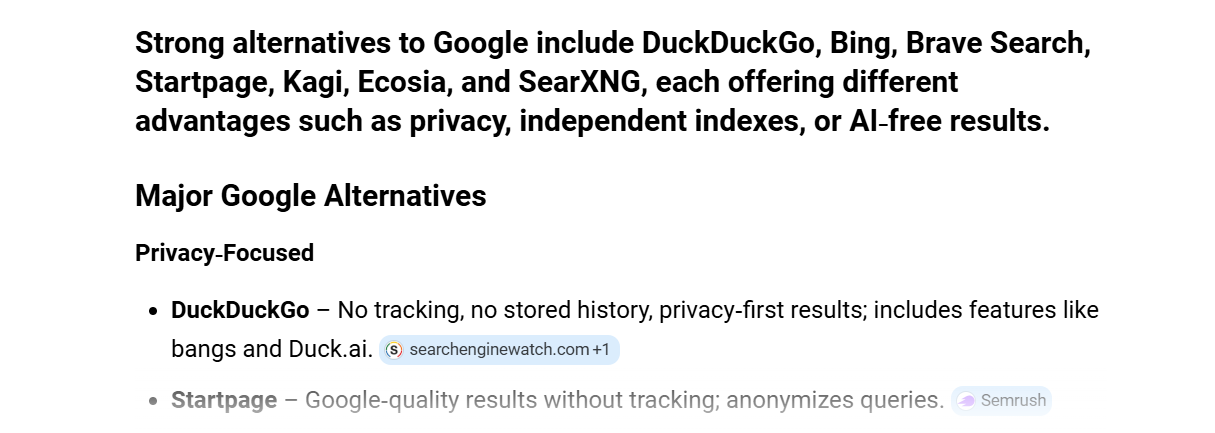

The above examples shows SearchEngineWatch.com inside a citation.

The citation leads to a fictional pricing page showing a three-user limit. That page supports the detail about users. You’d still need to check other requirements, such as how many contacts or monthly emails the plan allows, before choosing the tool.
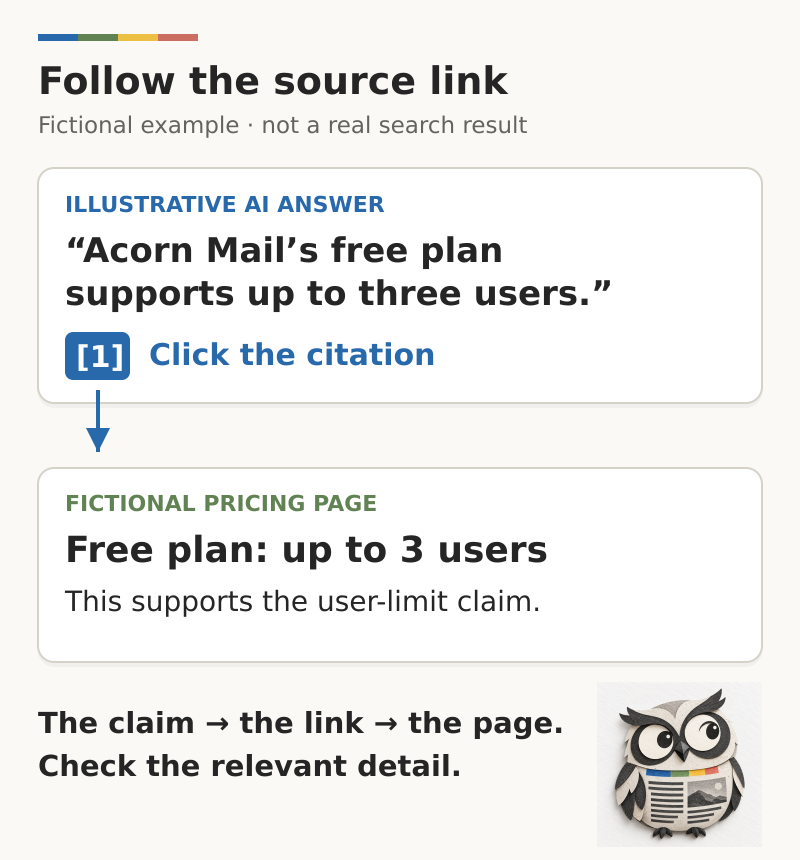
Notice the job of the source link: it lets you investigate a particular part of the answer. One source attached to a paragraph may support only some of its claims.

How do sources end up in an AI answer?

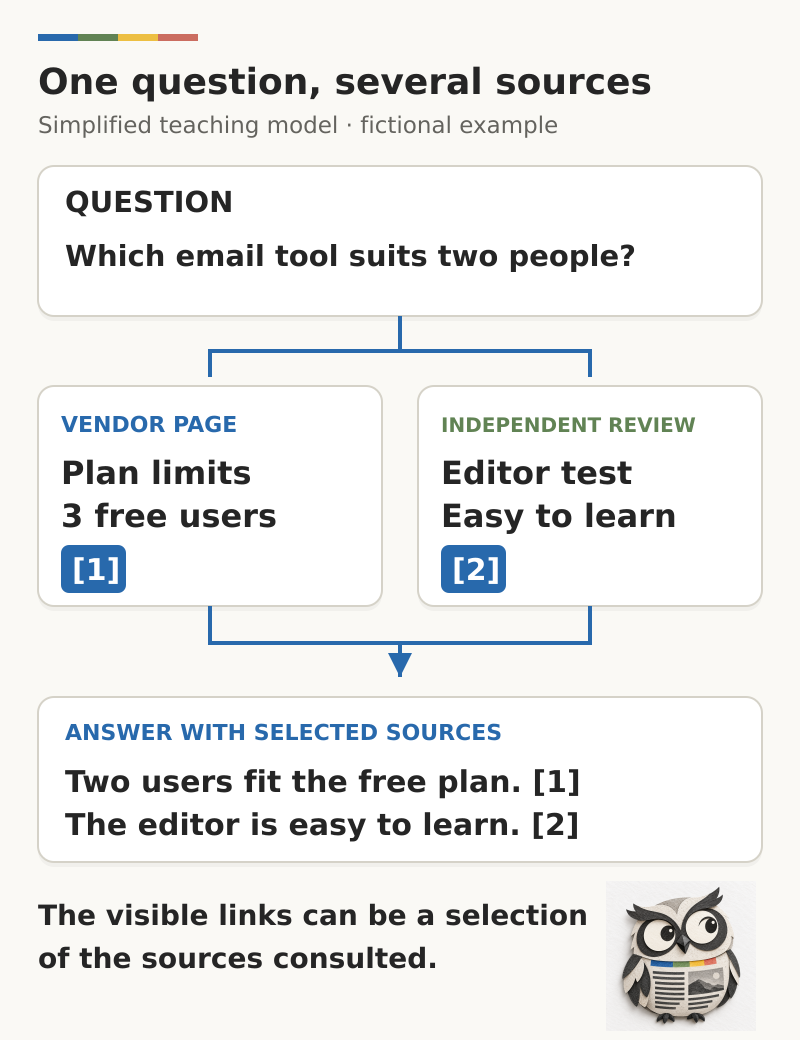
Many AI search experiences combine finding information with writing an answer. A useful way to picture the process is: the system searches for relevant material, uses information from the results and presents an answer with selected source references. Real systems can repeat those steps as they investigate a question.

Google calls one part of this process retrieval-augmented generation, or RAG. In its guide to generative AI search, Google explains that its systems retrieve pages from the Search index, review information on those pages and show links that support the response.

Return to our email-software question. A vendor’s pricing page might answer how many users the free plan allows. An independent review might explain how easy the editor is to use. An answer comparing options could draw on both kinds of information.

A broader question may lead to several related searches. Google says AI Overviews and AI Mode may use this technique, called query fan-out. Our plain-English explanation of query fan-out walks through how one question can branch into several searches.
Does the answer show every page the AI consulted?

The visible citations can be a smaller selection. For example, OpenAI’s API web-search documentation distinguishes the URLs consulted during a search from the references shown as inline citations. It says the number of consulted sources is often greater than the citation count.

That distinction helps explain why inspecting the finished answer gives you only part of the picture. If your URL is missing from the citations, the answer itself doesn’t tell you whether your page was never found or was considered without receiving a visible link. We explored that publisher problem in our reporting on content being retrieved without a citation.

What about the model’s training?

Training helps a language model learn patterns it can use to generate text. Searching for a source during an answer is a separate activity. A visible citation gives you a reference to inspect; it doesn’t provide a record of all the material involved in training the model.

OpenAI makes the distinction concrete in its crawler documentation: OAI-SearchBot is used for ChatGPT search, while GPTBot crawls content that may be used for model training. Website owners can manage those permissions independently.

A mention, a citation and a click tell you different things

An AI answer could name your business while citing a review on someone else’s website. It could also cite your research while recommending a different product. Look at both the wording of the answer and the destination of its links.

What happened? What it tells you
Brand mention: the answer names Acorn Mail. The brand appears in the answer text.
Citation: a source link points to Acorn Mail’s pricing page. The answer presents that page as a source.
Recommendation: the answer suggests choosing Acorn Mail. The answer favors that option in this particular context.
Referral visit: someone follows the link to the website. A person has arrived from the answer.

For a publisher, a citation may credit a useful piece of reporting. For a software company, the more valuable appearance might be a recommendation for a buyer whose requirements match the product. In either case, the reader can finish with the AI answer and leave without visiting the cited website.
How is an AI citation different from a backlink?

A backlink is a link to your page from another website. An AI citation is a source reference shown within an AI-generated response. Both can give someone a route to your page, but their context and reporting differ.

A citation you see in one answer records that appearance. It doesn’t tell you that the same link will appear for every person asking a similar question. Keep examples from AI answers in your visibility records, alongside any referral visits you can identify.

How do you check whether a citation supports the answer?

Open the source and compare its wording with the exact claim. That sounds obvious, but a link placed beside a confident sentence is easy to skim past.

In a 2023 study of four generative search engines, researchers found both unsupported statements and citations that failed to support the sentences attached to them. Those findings concern the systems tested at that time. They illustrate the reason for checking the claim against the page.

Imagine our fictional Acorn Mail answer now says its free plan includes unlimited users. The linked pricing page says the free plan allows three users and the paid plan allows unlimited users. The page exists and covers the right product, but the answer has assigned the paid-plan benefit to the free plan.
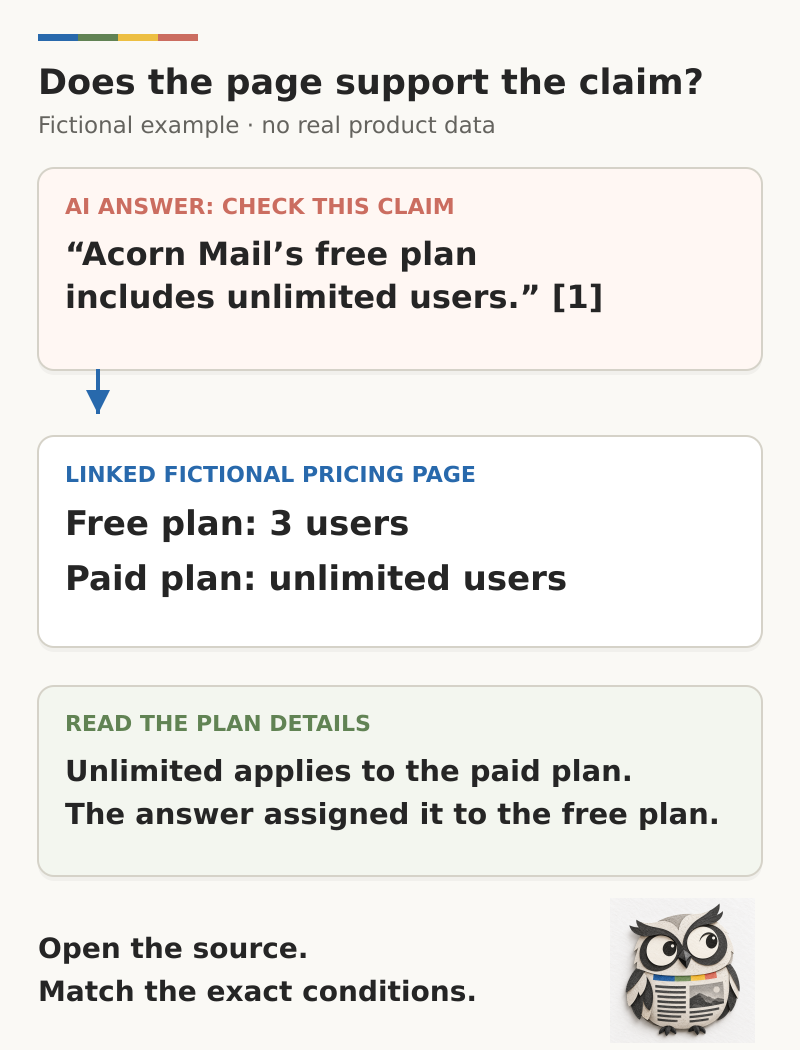
When checking a citation, follow these four steps:

  1. Open the destination. Check that the page exists and belongs to the publisher the answer identifies.
  2. Find the supporting passage. Look for the sentence, table or result behind the claim. A page on the same subject may still say something different.
  3. Match the conditions. Compare dates, product versions, countries, plans and units. A statement about a paid plan won’t answer a question about a free one.
  4. Follow the evidence upstream when needed. If the page summarizes a study or announcement, open the original and check its scope.

If the destination is inaccessible, you may be able to find an accessible original source. Until you can inspect the relevant evidence, keep that claim unresolved.
How can you make your pages useful as AI sources?

Start with a real question your page can answer and evidence that helps someone answer it accurately. For Acorn Mail, that could be a pricing page with clear limits for each plan. For an independent reviewer, it might be a documented test of an email editor, with the version tested and screenshots showing the task.

Those details make the source useful to a reader who follows a citation. They also give a search system concrete information to retrieve. Selecting your page still depends on the question and the platform.

Check whether the platform can access and include your content

Google’s AI-features guidance says a page must be indexed and eligible for a search snippet to appear as a supporting link in AI Overviews or AI Mode. Its current Search generative AI control documentation also explains the inclusion setting in Search Console. Inclusion is the default for top-level properties; a child property may inherit its parent’s choice.

For ChatGPT search, check the OAI-SearchBot rules described in OpenAI’s crawler guidance, along with any server or security rules that might block access. OpenAI says sites opting out of that bot won’t appear in ChatGPT search answers, although navigational links may still appear.

Publish information someone can inspect

Say what you tested, where a figure came from and which conditions apply. If you publish a survey, include who responded, when it ran and the questions asked. If you cover a software feature, show the relevant plan or version. If a price changes, update the page and make the current amount clear.

For our fictional tool, “Our free plan is ideal for growing teams” leaves the reader guessing. “The free plan allows three users and 500 contacts” gives them two limits they can compare with their needs. Those invented figures are a teaching example, not an observed product offer or citation result.

Organize the page around those questions with descriptive headings and readable tables where they help. Keep the evidence near the statement it supports, so a person arriving halfway down the page can understand it.

Keep the page readable for people

Google’s current optimization guide says you don’t need llms.txt files, special AI markup, an ideal page length or artificially chopped-up content for its generative search features. It also warns against producing pages for every query variation primarily to manipulate results.

How do you measure AI citations?

Begin with a small, repeatable set of questions relevant to your work. Save the answers and their source links, recording the platform, date, wording, language, location where relevant and whether web search was used. Repeat under comparable conditions, keeping each platform’s observations separate.

Define what you’re counting. You might count answers that contain at least one citation to your domain, distinct cited URLs, or individual citation markers. Those totals can differ when one answer cites several pages from the same website.

Here’s a simple illustrative example: you save 20 answers from one platform, and five contain at least one citation to your website. Your answer-level citation rate in that sample is:

5 ÷ 20 × 100 = 25%
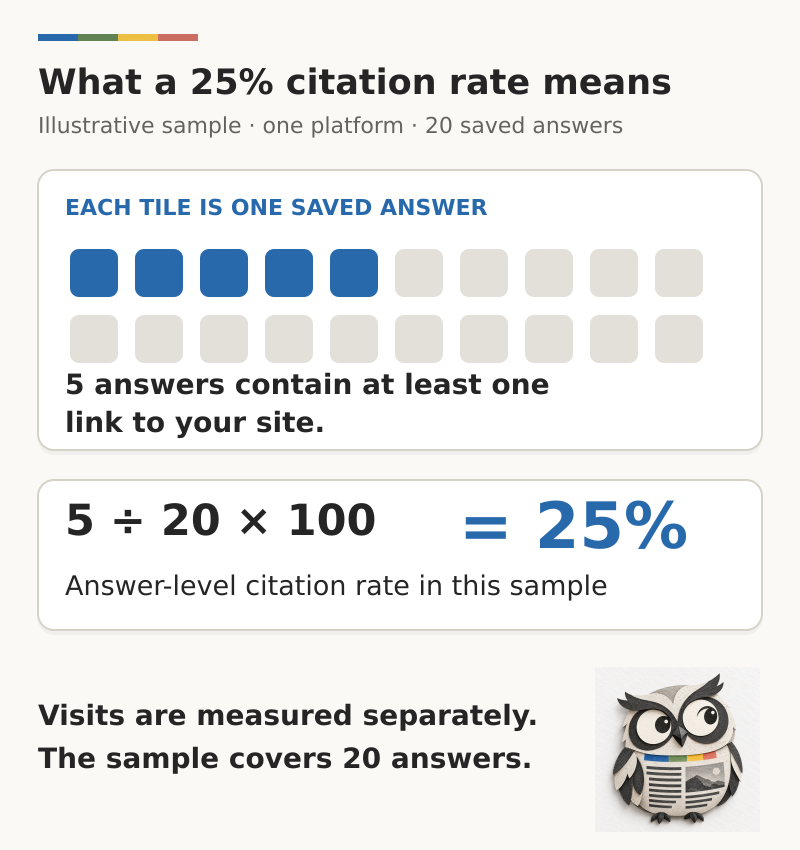
The percentage describes those 20 answers. Keep the prompt list and collection conditions with the result so the next sample is comparable. A tracking tool’s figure needs the same scrutiny: check its prompt coverage, platforms and counting method.

Measure visits and useful actions separately. Website analytics can help you identify reported referral traffic and what those visitors did, although referral information can be incomplete. An answer-level citation count won’t tell you how many people clicked.

For Google, the Generative AI performance report documentation describes impressions for AI Overviews and AI Mode. It says the report may be absent when a property has too few impressions, and also retains a rollout-access caveat. These impressions measure links being shown under Google’s counting rules, rather than appearances in your saved prompt sample.

Common questions about AI citations

Can an AI cite my website without naming my business in the answer?

Yes. The answer could use a fact from your page and link to it while discussing the subject rather than your business. Inspect the answer text and source links separately.

Can my brand be mentioned while another website receives the citation?

Yes. For example, an answer about your software could link to an independent review. Record the brand mention and the cited destination as separate observations.

Will adding sources to my article make AI cite it?

Sources let readers inspect your evidence and give your claims a clearer basis. Whether an AI answer links to your article depends on its retrieval and source selection. Adding a bibliography provides no guaranteed placement.

Can AI invent a reference?

Yes. A 2023 study of bibliographies generated by GPT-3.5 and GPT-4 found fabricated references as well as errors in real references. It examined older models writing literature reviews, rather than today’s web-search answers. Open and verify a reference before relying on it.

Is this the same as citing ChatGPT in an essay?

That is a separate question about acknowledging your use of an AI tool. Here, we’re explaining references an AI answer provides to other sources.

What should I do first?

Choose one question your website answers well. Look at an AI search answer to that question, open its citations and compare the linked pages with yours. You’ll see what information those sources provide and whether your own page offers a clear, supported answer.

The post What are AI citations? Who gets the credit when AI answers? appeared first on Search Engine Watch.

Source:: searchenginewatch.com
India’s deepfake rules hit inboxes: Google begins quarterly ToS reminder emails to users

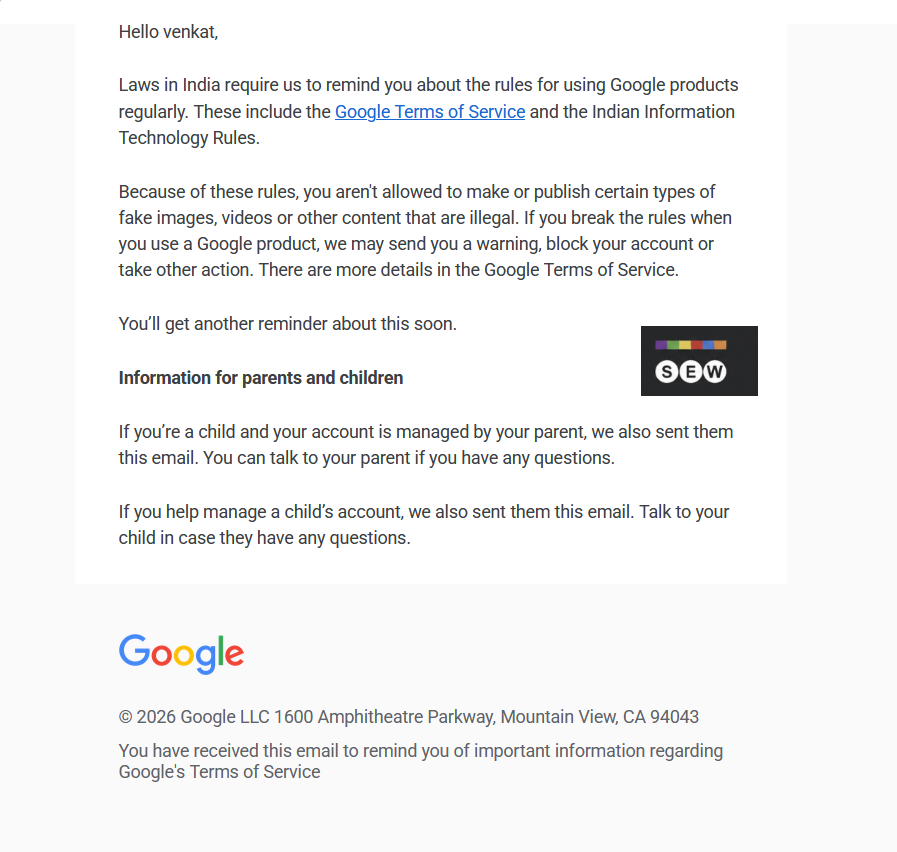
Google is sending an email reminder to users in India about its Terms of Service and India’s Information Technology Rules, including restrictions on creating or publishing illegal fake images and videos.

The message opens by explaining why the notice is being sent: “Laws in India require us to remind you about the rules for using Google products regularly.” It directs users to both Google’s Terms of Service and India’s Information Technology Rules.

Google warns that users cannot create or publish certain types of illegal fake content. Breaking these rules could lead to a warning, account suspension or other action. The notice also says users will receive another reminder soon.

Image Credit: Venkat | Search Engine Watch

The email comes as India’s 2026 amendments to its Information Technology Rules take effect. Under the updated rules, digital platforms must inform users at least once every three months about their rules and the consequences of breaking them. The amendments also introduced requirements covering synthetically generated information.

A dedicated section for families explains that parents who manage a child’s account will receive the same notice.

The post India’s deepfake rules hit inboxes: Google begins quarterly ToS reminder emails to users appeared first on Search Engine Watch.

Source:: searchenginewatch.com