Archiv für den Monat: Oktober 2026

Google Maps now requires sign-in to read more reviews

Requires Sign In To Read All Reviews

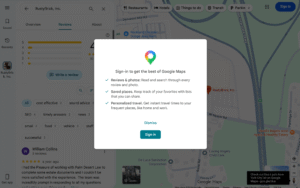
Google Maps is now requiring users to sign in before they can read more reviews. Clicking options like “See more reviews” or sorting through reviews now triggers a sign-in prompt.

We found this via SER, where the source suggested Google may have made this change to help prevent AI tools, bots, and third parties from scraping Google reviews.

Here is a screenshot of this.

I agree with this theory. Requiring sign-in to access expanded or sorted reviews could be an effective way for Google to limit automated scraping, especially as AI tools increasingly pull review data for summaries and other uses.

The post Google Maps now requires sign-in to read more reviews appeared first on Search Engine Watch.

Source:: searchenginewatch.com

Bing tests italic URL font style in search results again

Bing is testing an italic font style for URLs in both organic search results and sponsored ads. I remember Bing testing a similar stylized font about a year ago but hadn’t seen it since. Today, Bing appears to be testing this italic URL style again.

I checked Bing four to five times today, and most of the time, it showed this new italic font style. It seems like Bing is pushing this more aggressively today.

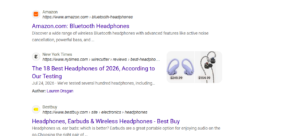
Here is a screenshot of this.

Using a distinct font style like this could help draw users‘ attention to the URL within search results.

The post Bing tests italic URL font style in search results again appeared first on Search Engine Watch.

Source:: searchenginewatch.com

AMD’s next AI move: an $8.2 billion deal for a company that builds virtual worlds

AMD has agreed to acquire World Labs, the AI research company founded by Fei-Fei Li, in an all-stock transaction valued at approximately $8.2 billion. This also comes shortly after World Labs introduced Atlas, its omni world model for spatial intelligence, on September 1.

The company also develops technology for robotic learning and simulation. The deal gives AMD a team working on spatial-intelligence models and brings Li into AMD as executive vice president and chief scientist, reporting to CEO Lisa Su.

The acquisition has not closed. AMD expects it to close by the end of 2026, subject to regulatory approvals and other customary closing conditions.

What AMD is buying

AMD says it is acquiring World Labs to gain deeper insight into how emerging AI workloads, including spatial intelligence, are evolving. World Labs develops spatial-intelligence models that can generate, reconstruct and simulate interactive 3D environments from text, image and video inputs.

In practical terms, this means an AI system can work with information about space rather than only producing a text or image response. World Labs‘ World API, for example, can generate navigable 3D environments from inputs including text, images and video.

For example, World Labs says the World API is being used by Escape.ai to turn 2D films into navigable 3D environments. Instead of only watching a video, a user can explore an environment generated from that visual material.

The example illustrates one way spatial AI could be used outside a research laboratory: as a capability built into another company’s product rather than as a standalone chatbot. This is an example supplied by World Labs, rather than independent testing.

The two companies already had a technical partnership focused on model training and inference optimization on AMD GPUs. World Labs says that partnership began last year.

By integrating this expertise, AMD says it will gain deeper insight into how AI workloads are evolving and use that knowledge to help shape its future hardware, software and systems. AMD has not announced a specific new chip or commercial product resulting directly from World Labs‘ technology.

What happens to Marble and the World API?

This is the part of the acquisition that remains unanswered.

World Labs currently offers Marble, a product for generating 3D worlds, alongside the World API for developers. Its platform provides access to Marble tutorials and API documentation, while the World API supports API keys, usage and billing.

Neither AMD’s acquisition announcement nor World Labs‘ September 28 announcement says what will happen to those products once the transaction closes.

There is no announced change to Marble’s pricing. There is no announced shutdown. There is no announced migration of World API customers to an AMD service.

For existing users, the useful thing to watch is whether the companies publish changes to product access, pricing, terms, API availability, support or data handling before the transaction closes.

What businesses should watch next

Businesses‘ most important question is how AMD connects World Labs‘ research with its broader AI infrastructure once the acquisition closes.

For now, the clearest change is organizational: World Labs is set to become part of AMD, and its research team will continue working on AI model research.

The effect on the products people already use remains a question for the companies to answer before the deal closes.

Whether the combined company produces new products, changes existing World Labs services or takes the technology in a different direction will become clearer as the transaction progresses.

The post AMD’s next AI move: an $8.2 billion deal for a company that builds virtual worlds appeared first on Search Engine Watch.

Source:: searchenginewatch.com
Instinct lands $1 billion to build an AI assistant that actually runs your errands

Instinct has raised $1 billion in new funding as the AI company expands its personal agent beyond digital tasks and into real-world errands, including making phone calls to businesses on a user’s behalf.

The funding values Instinct at $10 billion, according to Reuters. The company says its agent can help with tasks such as trip planning, groceries, tickets and cancelling subscriptions, while its Concierge service can call businesses that do not offer online booking.

For users, the more important question is what happens when an agent can actually commit them to something.

What can Instinct Concierge do?

Instinct announced its Concierge service earlier in September, describing an agent that can make phone calls and handle tasks such as restaurant reservations and joining a dentist’s cancellation list.

That moves the agent beyond finding information or preparing a recommendation. It can interact with another business and potentially create a real-world commitment.

That distinction makes the approval process important.

Bookings require user approval

Instinct’s task documentation describes a phone-only booking workflow in which the agent calls the business, reports what happened and does not commit to a booking without the user’s approval. The user is expected to review the details and confirm the booking and its terms before anything is agreed, booked or paid for. This example is based on a community report rather than an independently verified test.

For example, a user could ask the agent to call a restaurant that only accepts reservations by phone. The agent can establish whether a table is available and report back the proposed time and any relevant conditions. The user then decides whether to accept those terms.

This is an important distinction from giving an agent unrestricted authority to make bookings. A phone call could produce a different time, a deposit requirement or cancellation conditions that were not known when the task was started.

The agent still makes decisions

Instinct says it has added privacy and security measures including isolated sandboxes, short-lived local credentials and an active detection system designed to identify subtle hallucinations before the agent responds or executes an action. Those are company claims and not results from independent testing.

There have also been reports of users encountering unexpected behavior when agents interact with booking services. The Atlantic reported an example involving an apparent reservation made without the user’s intended approval, but this is an individual reported incident and not evidence of how Instinct generally behaves.

The same permission question is emerging across the wider agent market. For example, Amazon blocking Meta’s Muse shopping agent. This shows that an agent can have permission from its user but still encounter restrictions imposed by the service it is trying to use.

What the funding means for users

The $1 billion raise gives Instinct additional resources to expand its agent, but the more significant change for users is the widening range of actions it can attempt on their behalf.

As AI agents move from researching tasks to carrying them out, the useful question is no longer simply what an agent can do. It is which actions require approval, what information the user sees before approving them, and what happens when the agent gets something wrong.

That is where Instinct’s approval-first approach will matter in practice as Concierge expands.

The post Instinct lands $1 billion to build an AI assistant that actually runs your errands appeared first on Search Engine Watch.

Source:: searchenginewatch.com

Google tests Try on button directly in SERP carousels

try on

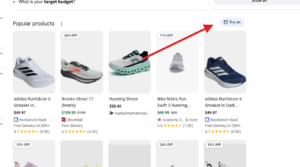
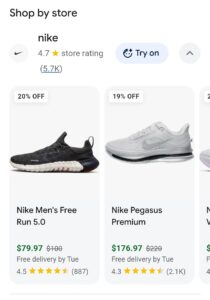
Google is testing a new placement for its “Try on” button within SERP carousels. Previously, this button only appeared after a user opened the carousel. Today, while searching for an ecommerce query, I noticed Google showing the “Try on” button directly within the SERP, rather than only inside the opened carousel.

Here is a screenshot of how it looks.

Try on button Try on button

Showing the “Try on” button above the carousel, visible before even opening it, is a notable change from how this feature previously worked.

The post Google tests Try on button directly in SERP carousels appeared first on Search Engine Watch.

Source:: searchenginewatch.com