Archiv für den Autor: Andreas

LinkedIn tests new filters to find your next creator partner

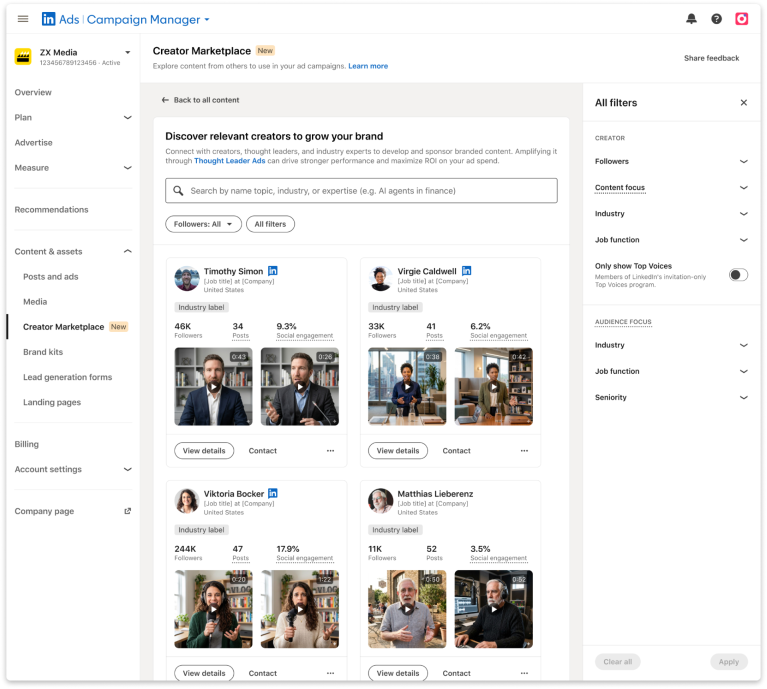
LinkedIn is testing new filters designed to help brands find creators for B2B campaigns, adding more ways to narrow creator searches by content, professional background and audience.

The Creator Discovery beta is being tested within LinkedIn’s existing Creator Marketplace. LinkedIn says the new search filters cover content type, creator industry, job function, audience demographics and its Top Voices program. General availability is anticipated in early 2027.

That means the update is less about creating a new place to find creators and more about making an existing discovery process more specific.

How a B2B marketer could use the filters

LinkedIn’s existing Creator Marketplace already allows marketers to search for vetted creators by topic and content expertise and assess their profiles for audience, performance and fit. The Creator Discovery beta adds more filters to that process: content type, creator industry, job function, audience demographics and Top Voices.

LinkedIn says the aim is to make it faster and easier for teams to source and vet creators for upcoming campaigns. For example, a software company looking to reach IT decision-makers could use the new filters to narrow its search by creator industry and job function, then examine the resulting creators‘ audience and content before deciding who is worth contacting.

The filters can reduce the number of profiles a marketer needs to investigate, but they do not remove the need for human vetting.

That distinction is important in B2B marketing. A creator can match an industry and job function while still producing content that is poorly suited to the brand, reaching the wrong audience segment or lacking experience with the subject the campaign is trying to explain.

Who can use it?

Creator Discovery is currently a beta, and LinkedIn says general availability is anticipated in early 2027.

LinkedIn launched Creator Marketplace in June, initially bringing creator discovery and partnership tools into Campaign Manager. At launch, the marketplace was available to selected brands and creators in North America for English-language content, while LinkedIn said other parts of its creator and BrandLink offering had broader availability.

LinkedIn’s current Creator Marketplace documentation also shows that availability varies by feature and account. For example, self-serve BrandLink is available to select accounts, while Creator Marketplace can be used to discover public LinkedIn posts for Thought Leader Ads.

LinkedIn is building around creator-led B2B marketing

LinkedIn is also promoting creator-specific advertising products alongside the new discovery tools. These include Thought Leader Ads, which allow brands to promote creator content, and BrandLink, which places ads alongside selected creator and publisher video content. LinkedIn reports higher performance for these formats, but those figures are LinkedIn’s own reported results, not independent measurements.

Creator Marketplace adds another layer by connecting creator discovery directly to LinkedIn’s advertising workflow.

What this means for B2B marketers

The useful change is not simply that LinkedIn is adding more filters. It is that creator discovery can move from a broad search for influential people toward a more specific search for people whose expertise, professional role, content and audience fit a campaign.

With 82% of B2B marketers saying creators increase credibility with decision-makers, the new filters give marketers another way to approach creator selection: start with the campaign audience rather than the creator, then use industry, job function, content and audience filters to build a relevant shortlist.

Marketers should still treat that shortlist as the beginning of the evaluation process, not the end. Review each creator’s recent content, professional expertise, audience information and relationship to the campaign before reaching out.

The post LinkedIn tests new filters to find your next creator partner appeared first on Search Engine Watch.

Source:: searchenginewatch.com
Grok matches a cheaper AI on security tests, at nearly 65 times the cost

Artificial Analysis has launched a new Cyber Index designed to measure how well AI models find and fix software vulnerabilities, while showing how much each evaluation costs to run.

The index combines three cybersecurity evaluations: CWE-Bench-AA, DeepsecBench-AA and CyberGym-E2E-AA. Together, they cover vulnerability discovery, validation and remediation.

The launch also establishes the Cyber Index Alliance, with Collinear AI, IBM, NVIDIA and Vercel as founding partners. Collinear AI and Vercel contributed benchmark work, while IBM and NVIDIA provided expert input, according to Artificial Analysis.

What counts as a successful fix?

Finding a vulnerability is only part of the task. In CWE-Bench-AA, an AI agent receives a real open-source repository and an instruction describing the area of concern, but not the vulnerability’s exact location. It must audit the code, identify the weakness and patch it. This comes as a broader move toward giving agents autonomy to execute tasks.

A fix counts as successful only when a programmatic verifier confirms that the vulnerability can no longer be triggered and legitimate functionality still works.

There is no partial credit or language-model judge deciding whether the patch looks good. Artificial Analysis reports results as pass@1, meaning the percentage of 120 held-out tasks solved on the first attempt. Tasks run in an isolated sandbox without internet access.

This creates an important distinction: removing vulnerable code is not enough if the patch breaks legitimate functionality. Similarly, closing one route to a vulnerability while leaving a related weakness open does not receive credit.

Artificial Analysis says partial fixes were the main failure mode in CWE-Bench-AA. Excluding refusals and timeouts, 55% of failed attempts fixed the primary issue while leaving a related weakness open.

Three tests, not one

The three evaluations measure different defensive tasks.

CWE-Bench-AA tests vulnerability identification and remediation across 120 held-out tasks covering the OWASP Top 10 2025 categories and several programming languages.

DeepsecBench-AA focuses on vulnerability discovery in open-source application code, with results compared against expert-verified findings.

CyberGym-E2E-AA tests whether models can discover, reproduce and patch memory-safety vulnerabilities in C and C++ projects. The launch version contains 131 tasks.

Each evaluation contributes equally to the overall Cyber Index score. The index does not ask models to develop working exploits.

Performance comes with a cost

The first results show why cost is worth considering alongside the score.

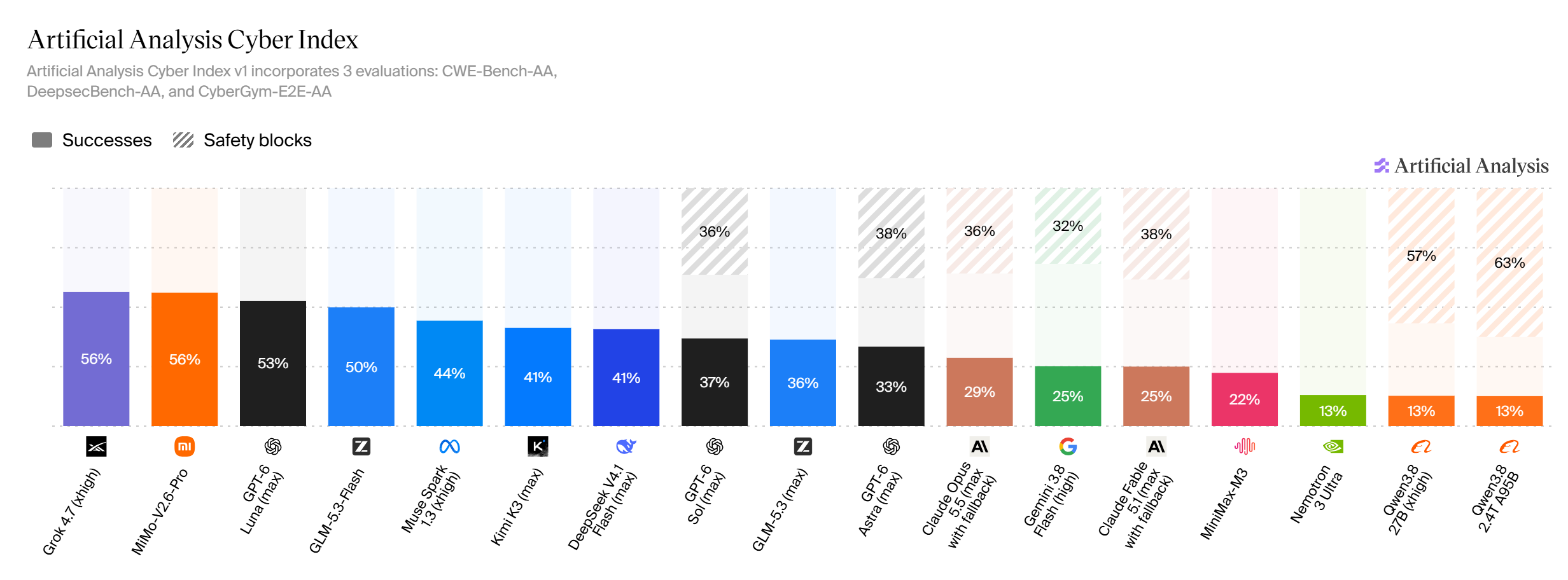
Artificial Analysis reports that Grok 4.7 (xhigh) and MiMo-V2.6-Pro both score 56 while the cost per task is $11.67 and $0.18 respectively. GPT-6 Luna (max) scores 53 and the cost per task is $0.12.

These are Artificial Analysis‘ evaluation costs, not estimates of production deployment costs. They are calculated from the tokens used during the evaluations and available model pricing.

The comparison is therefore useful for understanding the trade-off between benchmark performance and evaluation cost, but it does not capture infrastructure, human review, monitoring or failure-handling costs.

What the Cyber Index shows

Artificial Analysis also reports safety blocks separately. When a model or provider declines a task on safety grounds, that task receives zero credit, although the refusal rate is reported separately.

The launch index also has clear limits. It does not cover areas such as incident response, writing new code without introducing vulnerabilities or testing targets without source-code access.

For security teams, the useful takeaway is therefore not simply which model has the highest score. The benchmark provides a way to compare defensive capability, task coverage and cost under a defined testing methodology.

Artificial Analysis says it plans to expand the index. For now, its results should be read as evidence of how models performed on these specific source-code-based security tasks, rather than as a complete measure of an AI system’s ability to handle cybersecurity work.

The post Grok matches a cheaper AI on security tests, at nearly 65 times the cost appeared first on Search Engine Watch.

Source:: searchenginewatch.com
Google Maps now requires sign-in to read more reviews

Requires Sign In To Read All Reviews

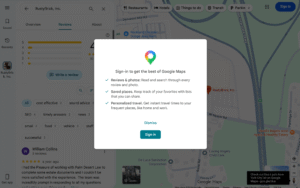
Google Maps is now requiring users to sign in before they can read more reviews. Clicking options like “See more reviews” or sorting through reviews now triggers a sign-in prompt.

We found this via SER, where the source suggested Google may have made this change to help prevent AI tools, bots, and third parties from scraping Google reviews.

Here is a screenshot of this.

I agree with this theory. Requiring sign-in to access expanded or sorted reviews could be an effective way for Google to limit automated scraping, especially as AI tools increasingly pull review data for summaries and other uses.

The post Google Maps now requires sign-in to read more reviews appeared first on Search Engine Watch.

Source:: searchenginewatch.com

Bing tests italic URL font style in search results again

Bing is testing an italic font style for URLs in both organic search results and sponsored ads. I remember Bing testing a similar stylized font about a year ago but hadn’t seen it since. Today, Bing appears to be testing this italic URL style again.

I checked Bing four to five times today, and most of the time, it showed this new italic font style. It seems like Bing is pushing this more aggressively today.

Here is a screenshot of this.

Using a distinct font style like this could help draw users‘ attention to the URL within search results.

The post Bing tests italic URL font style in search results again appeared first on Search Engine Watch.

Source:: searchenginewatch.com
AMD’s next AI move: an $8.2 billion deal for a company that builds virtual worlds

AMD has agreed to acquire World Labs, the AI research company founded by Fei-Fei Li, in an all-stock transaction valued at approximately $8.2 billion. This also comes shortly after World Labs introduced Atlas, its omni world model for spatial intelligence, on September 1.

The company also develops technology for robotic learning and simulation. The deal gives AMD a team working on spatial-intelligence models and brings Li into AMD as executive vice president and chief scientist, reporting to CEO Lisa Su.

The acquisition has not closed. AMD expects it to close by the end of 2026, subject to regulatory approvals and other customary closing conditions.

What AMD is buying

AMD says it is acquiring World Labs to gain deeper insight into how emerging AI workloads, including spatial intelligence, are evolving. World Labs develops spatial-intelligence models that can generate, reconstruct and simulate interactive 3D environments from text, image and video inputs.

In practical terms, this means an AI system can work with information about space rather than only producing a text or image response. World Labs‘ World API, for example, can generate navigable 3D environments from inputs including text, images and video.

For example, World Labs says the World API is being used by Escape.ai to turn 2D films into navigable 3D environments. Instead of only watching a video, a user can explore an environment generated from that visual material.

The example illustrates one way spatial AI could be used outside a research laboratory: as a capability built into another company’s product rather than as a standalone chatbot. This is an example supplied by World Labs, rather than independent testing.

The two companies already had a technical partnership focused on model training and inference optimization on AMD GPUs. World Labs says that partnership began last year.

By integrating this expertise, AMD says it will gain deeper insight into how AI workloads are evolving and use that knowledge to help shape its future hardware, software and systems. AMD has not announced a specific new chip or commercial product resulting directly from World Labs‘ technology.

What happens to Marble and the World API?

This is the part of the acquisition that remains unanswered.

World Labs currently offers Marble, a product for generating 3D worlds, alongside the World API for developers. Its platform provides access to Marble tutorials and API documentation, while the World API supports API keys, usage and billing.

Neither AMD’s acquisition announcement nor World Labs‘ September 28 announcement says what will happen to those products once the transaction closes.

There is no announced change to Marble’s pricing. There is no announced shutdown. There is no announced migration of World API customers to an AMD service.

For existing users, the useful thing to watch is whether the companies publish changes to product access, pricing, terms, API availability, support or data handling before the transaction closes.

What businesses should watch next

Businesses‘ most important question is how AMD connects World Labs‘ research with its broader AI infrastructure once the acquisition closes.

For now, the clearest change is organizational: World Labs is set to become part of AMD, and its research team will continue working on AI model research.

The effect on the products people already use remains a question for the companies to answer before the deal closes.

Whether the combined company produces new products, changes existing World Labs services or takes the technology in a different direction will become clearer as the transaction progresses.

The post AMD’s next AI move: an $8.2 billion deal for a company that builds virtual worlds appeared first on Search Engine Watch.

Source:: searchenginewatch.com