Kategorie-Archiv: SEO

OpenAI tests ChatGPT ads that skip the advertiser’s website

OpenAI is testing ads that open a conversation with a brand’s AI agent inside ChatGPT, giving advertisers a way to handle customer questions before anyone reaches their website.

According to Digiday’s September 14 report, the format has been introduced to selected clients. A button such as “Chat with us” takes the user into a branded conversation within ChatGPT. Digiday says it reviewed and verified video of the experience.

Wayfair confirmed its participation to Digiday, describing a limited Sponsored Agent pilot with safeguards covering product accuracy, transparency and handoffs to service teams. OpenAI did not respond to the publication’s request for comment.

The sales pitch moves off the landing page

OpenAI had already outlined this direction in its January advertising announcement, suggesting that users would eventually be able to ask an ad questions to help them decide what to buy. In its August 31 update, it again said it would explore more native ways for businesses to interact with consumers inside ChatGPT.

For advertisers, the practical change is where part of the selling happens. A landing page normally has to anticipate a visitor’s questions through product descriptions, specifications and FAQs. A conversational destination could let the visitor ask directly.

Consider a furniture shopper checking whether a desk fits an awkward corner. An effective agent could clarify the measurements before directing them toward a purchase. An unreliable one could misstate a dimension or delivery condition. Those are illustrative possibilities, rather than observed results from this pilot.

That makes the quality of the agent’s answers part of the advertising experience. Campaign teams would need to assess the information behind those answers alongside the creative that gets people to click.

Talking to the brand changes what it can see

OpenAI’s advertising FAQ already distinguishes between private ChatGPT conversations and messages deliberately sent to an advertiser. It says advertisers cannot access users‘ private chats, histories or memories. But when someone chooses to message an advertiser through an ad, the advertiser can see the messages sent directly to it.

The same FAQ describes a separate “Ask ChatGPT” feature, which lets someone share an ad with ChatGPT and ask about it. OpenAI says advertisers do not influence those responses.

That distinction matters here: asking ChatGPT to assess an offer and entering a conversation with the seller’s agent serve different purposes. The interface needs to make clear which conversation the user has entered, particularly when both happen in the same app.

An ad click no longer guarantees a website visit

OpenAI’s existing conversion measurement documentation explains how advertisers report purchases and leads through its Pixel, Conversions API or both. It also describes a click reference added to landing-page URLs that helps connect subsequent activity to an ad.

That documentation does not establish how the Sponsored Agent pilot measures the extra conversation before a possible website visit. Digiday’s report does not specify its pricing or detailed reporting capabilities.

Advertisers evaluating this format would need to distinguish between a conversation starting, a shopper reaching their site and a purchase completing. A chat could answer a useful question without producing an immediate visit; it could also add another step where a potential customer drops out. Counting chat openings alone would leave that difference unresolved.

SEW’s guide to running ChatGPT ads explains how to evaluate website campaigns against actual purchases or qualified leads. A conversational campaign needs the same commercial discipline, with visibility into what happens between the ad interaction and the eventual outcome.

For now, the evidence establishes a limited pilot. It does not establish that the format is generally available or that a branded AI conversation produces better sales results than a website destination.

The post OpenAI tests ChatGPT ads that skip the advertiser’s website appeared first on Search Engine Watch.

Source:: searchenginewatch.com
OpenAI can reject ChatGPT ads simply for competing with its own business

OpenAI has explicitly reserved the right to reject ChatGPT advertisements that conflict with its commercial interests, giving competing businesses another condition to consider before buying ads.

The company’s advertising policy, updated September 10, says it can decline advertisers and refuse ads or website links for reasons including its “business interests, or competitive position.” The September changelog describes the update as a clarification of that right.

The wording makes competition with OpenAI an explicit consideration alongside its advertising principles. However, the public page does not name excluded companies or specify a blanket ban on rival AI products.

The Information reported restrictions on rival standalone image and audio tools, affecting Adobe; Search Engine Land’s summary says video tools remain eligible.

Adobe’s involvement gives the development particular significance. On February 9, the company announced its participation in OpenAI’s advertising pilot, explicitly naming Acrobat Studio and Firefly as products it would promote through WPP. Adobe said it would work with OpenAI to explore how advertising could fit into ChatGPT.

OpenAI subsequently named Adobe among its advertising technology partners when it introduced a beta self-service Ads Manager in May. That announcement explained that partners could help advertisers manage budgets, bids and creative assets, while OpenAI retained control over ad delivery.

For businesses planning campaigns, that distinction matters. A partner can provide a way to purchase advertising, but the platform still decides whether a particular product can appear.

OpenAI’s advertising terms, updated August 25, already spell out that control. Campaign acceptance is at the company’s discretion. Access to Ads Manager or an advertising API does not guarantee campaign approval or delivery. A separate provision allows OpenAI to exclude individual advertisers or entire advertiser categories.

Those general terms establish OpenAI’s control over access. They do not independently confirm which Adobe campaigns were rejected or when any product-specific restriction began.

For companies preparing their first campaign, our guide to running ads on ChatGPT explains the separate checks for account access, product eligibility and campaign review. Completing registration does not mean every product a business sells can be advertised.

The clarification also arrives as more advertising businesses connect to ChatGPT. As SEW reported on September 10, Amazon has begun a ChatGPT advertising pilot allowing selected U.S. advertisers to buy placements inside the app.

The formats are developing too. SEW has documented ChatGPT’s product carousel ads, which display several products from one advertiser. Google is also testing ads between sections of its AI Mode answers. These developments give marketers new placements to evaluate, subject to each platform’s eligibility rules.

For users, paid placements and ChatGPT’s answers remain separate questions. OpenAI’s published advertising principles say advertisements do not influence responses and must be clearly labelled. Restrictions on advertising access do not, by themselves, establish that competing products are excluded from ordinary recommendations.

For an AI company considering ChatGPT as a source of customers, the practical uncertainty comes before campaign performance: whether OpenAI will approve the product being advertised, and whether that approval will continue.

The post OpenAI can reject ChatGPT ads simply for competing with its own business appeared first on Search Engine Watch.

Source:: searchenginewatch.com

Google details partner-only search API as Custom Search nears shutdown

Google has updated documentation for a service that lets approved partners add full-web Google search results to their websites and apps. The details arrive as customers of its older Custom Search JSON API face a January 1, 2027 shutdown.

The Web Search Service API requires a Google Cloud project, an API key and a client ID tied to a partner agreement. Its public documentation does not explain which businesses qualify, what access costs or how long approval takes.

For developers using the outgoing API, the immediate question is whether they can move to this service before their existing access ends.

Google’s Custom Search JSON API notice says the product is closed to new customers and will be discontinued on January 1. Existing customers currently receive 100 free queries a day, with additional requests priced at $5 per 1,000, up to 10,000 queries daily.

Google has not published an equivalent price or daily allowance in the Web Search Service pages reviewed.

In its January migration announcement, Google directed customers needing full-web results to an interest form. That announcement does not name the Web Search Service API, and the API documentation does not explicitly confirm it as the replacement for existing customers.

The interest form asks businesses about their expected search volumes and required features. It also warns that replies are on a “best effort” basis. Submitting it provides no published guarantee of acceptance or a response before the shutdown.

The technical documentation is more specific. The API reference describes results containing page titles, URLs and snippets, with up to 20 results per request and an option to retrieve further pages. Developers can filter results by language, country and date.

For SEO tools, one limitation matters: the documented response contains no dedicated fields for AI Overviews, search ads or local map results. The pages also do not promise that results will appear in the same order as they do on Google.com.

Every search request must include the end user’s IP address, which Google says supports regional routing and abuse prevention.

The post Google details partner-only search API as Custom Search nears shutdown appeared first on Search Engine Watch.

Source:: searchenginewatch.com

Google tests payments for content used in AI answers, but pricing remains unclear

Google is testing payments to publishers whose content helps produce answers in Gemini, AI Overviews and AI Mode. Participants can see their earnings, but receive little information about how Google calculates them, according to Digiday.

The “AI contribution pilot” adds an earnings panel to Google Search Console. Payments depend on whether Google considers a publisher’s content to have made a significant contribution to an answer. They are not calculated simply by counting how often the content is used.

Google confirmed the pilot to Digiday, describing it as an early experiment in rewarding useful content. Publishers can opt out.

The company outlined the broader initiative in June, saying it was testing partnerships with websites that help keep AI responses accurate and up to date. The content is used for grounding, which means consulting source material when producing an answer. That is a different use from training a model. Google’s announcement did not provide payment rates or explain the calculation.

Publisher reactions have been mixed. One source told Digiday that early returns were “peanuts” compared with advertising revenue. An executive said offers were too low to justify joining. Other participants welcomed the direct payments and regular discussions with Google, despite wanting more transparency.

Those accounts do not establish typical earnings across the pilot. Digiday did not publish a standard rate or enough payout data to make that comparison.

Google has separately introduced AI performance reports in Search Console, which it says became available worldwide on August 31. They show how often a site’s pages appear in generative AI Search features, with breakdowns by page, country, date and, for Search, device.

These reports measure visibility. An appearance count alone cannot explain a payment based on the value of a contribution. A publisher would also need to know which uses qualified for payment and how Google valued them.

Google also rolled out a control for excluding content and links from generative AI Search features. The company says using it is not a ranking signal for results outside those features. Sites that opt out also lose the impressions and traffic they could receive from those AI experiences. This control is separate from participation in the payment pilot.

The payments come amid concerns about AI answers reducing visits to publishers. A Pew Research Center study of 900 US adults‘ browsing in March 2025 found that users clicked traditional results on 8% of visits to search pages with an AI summary, compared with 15% on pages without one. Links within AI summaries received clicks on 1% of visits to pages containing a summary.

The study predates the pilot and does not measure its participants‘ traffic or revenue. Whether Google’s payments can offset any lost business remains unproven.

The post Google tests payments for content used in AI answers, but pricing remains unclear appeared first on Search Engine Watch.

Source:: searchenginewatch.com

Microsoft Copilot prompts users to sign in mid-response

Microsoft Copilot

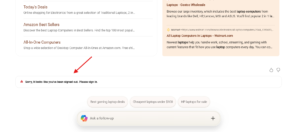
Microsoft Copilot is now showing users an answer at the beginning of a response, but then displaying a message at the end: “Sorry, it looks like you’ve been signed out. Please sign in.” This suggests Microsoft wants users to sign in before continuing.

Here is a screenshot of this.

This fits a broader pattern we’ve seen across search engines and AI tools recently, nudging users toward signing in for a more personalized or complete experience, rather than allowing fully anonymous use.

The post Microsoft Copilot prompts users to sign in mid-response appeared first on Search Engine Watch.

Source:: searchenginewatch.com