Archiv für den Monat: September 2026

Google’s bot crackdown is messing with your SEO reports

Changes to how Google delivers search results are disrupting some SEO tools‘ data collection, making recent ranking charts harder to interpret. Sistrix’s September 16 status update confirms that collection is running more slowly while it adapts its systems.

Nozzle’s Derek Perkins told Search Engine Roundtable’s Barry Schwartz that the amount of data he could retrieve from Google had fallen by about 80%. That figure describes his collection results; it does not measure a decline in websites‘ rankings or traffic.

The effects appear uneven. Schwartz also reported Glenn Gabe’s comparison of a site whose traffic had recovered after a sharp fall. Ahrefs reflected the recovery, Semrush showed it with a delay, and Sistrix had not picked it up. That example illustrates a reporting lag, but cannot establish the reliability of each provider across its entire database.

Google’s redirects were an earlier obstacle

SEW previously covered Google’s rollout of opaque /goto redirects, which made collecting destination URLs more laborious. Tools had to follow those redirects to discover which websites appeared in the results.

Sistrix says it resolved the resulting processing delays by September 1. Its September 16 notice reports further changes without identifying the mechanism, so the latest slowdown should not automatically be blamed on the same redirects.

Google’s published spam policies explicitly include unauthorized scraping for rank checking under prohibited automated traffic. The policy establishes Google’s position, but does not explain this particular incident.

Missing data can outlast the disruption

Sistrix’s status history contains a detail worth checking before using these charts in a client report. After a separate disruption in August, the company said normal daily keyword updates had resumed, but data from the affected days could not be updated retrospectively. A provider can fix collection and still leave gaps in the historical record.

That makes the date of the last successful collection, and whether missing periods will be filled, essential questions for affected vendors. SEW’s comparison of SEO data suppliers explains why freshness and coverage matter when evaluating retrieved results. A dashboard that opens normally offers no assurance that every keyword was checked on schedule.

For your own website, compare a suspected drop with Search Console’s clicks and impressions and your recorded organic traffic over the same dates. Those metrics measure different things, but can help establish whether a visibility-chart movement coincided with a change in actual visits. Competitor charts deserve more caution when that corroborating data is unavailable, especially if the provider cannot confirm when it last collected the underlying rankings.

Source: Search Engine Roundtable.

The post Google’s bot crackdown is messing with your SEO reports appeared first on Search Engine Watch.

Source:: searchenginewatch.com
Google Ads lets brands use retailer audiences, but traffic stays on the retailer’s site

Google has published instructions for “commerce audience sharing through Google Ads.” The feature lets retailers and marketplaces share first-party data segments with brands and sellers. In plain English, a retailer can let a brand target people from the retailer’s own shopper data.

Google says campaigns using the shared audience must send traffic back to the commerce partner’s website. The audience can be used in Performance Max, Search, Standard Shopping, Demand Gen and Video campaigns, but the brand cannot send that audience wherever it chooses.

Search Engine Roundtable reported the new help document. Google’s broader Commerce Media through Google Ads documentation says the program is limited to participating merchants. Interested brands must contact their commerce partners or Google Ads account team.

How Google Ads audience sharing works

The retailer must link the brand’s Google Ads account to its Google Ads data-sharing account and Merchant Center account. Once approved, shared segments appear in Audience Manager with a “Shared” badge. Brands can add them to eligible campaigns and combine them with their own first-party data.

The retailer controls which segments are shared and can specify the approved campaign domain. Google says retailers receive impression, click, conversion and spend metrics from partner campaigns. Brands receive audience details, product information and conversion data from the retailer’s website.

Google’s campaign setup instructions add several practical restrictions. Campaigns need at least 10 approved SKUs. Google recommends a campaign duration of at least 30 days and a daily budget of $40 or more. Final URL expansion and text customization must remain disabled.

The retailer keeps the destination

The brand gets a retailer’s shopping signal and conversion feedback, but not a portable audience it can activate elsewhere. The retailer decides which audience is available, approves the domain and configures the purchase and add-to-cart goals.

That may suit sellers already dependent on a marketplace. A direct-to-consumer brand would need to decide whether the retailer’s conversion data is worth giving up control of the destination.

Google is connecting retailer audiences, product feeds and purchase reporting to brand-funded campaigns across its advertising surfaces. The setup is useful where the retailer owns the conversion path, but it is not a replacement for a brand’s own Customer Match or remarketing audiences. Google does not publish a list of participating merchants, so availability remains a partnership question rather than a setting most advertisers can switch on.

The post Google Ads lets brands use retailer audiences, but traffic stays on the retailer’s site appeared first on Search Engine Watch.

Source:: searchenginewatch.com
Google Merchant Center puts product reviews on the API menu

Google has updated its Merchant Center documentation to list the Merchant API as an official way to submit product reviews.

Search Engine Roundtable spotted the change. The help page previously said APIs were not supported for product review data sources. It now includes “Add product reviews using API” alongside file uploads, scheduled fetches, SFTP and Google Cloud Storage.

For larger retailers, that means review data can be managed programmatically instead of repeatedly shuffling XML files around.

Google’s Merchant API can create or update product reviews, retrieve individual reviews, list reviews and delete them.

There is still some paperwork.

Merchants need to be enrolled in Google’s Product Ratings program, and Google says applicants should have at least 50 product reviews. A Google agent must approve the account before Product Ratings is enabled. API users also need to submit an allowlist request through Google’s Shopping API support form.

Not quite a brand-new API

One wrinkle: the underlying Reviews sub-API itself is not new.

Google’s API release notes show the Reviews sub-API entered beta back in October 2024, with additional review-related features arriving since then. What appears to be new here is Google formally adding the API workflow to its Merchant Center product-review documentation.

Our take

For merchants managing hundreds or thousands of reviews, this is less glamorous than another AI shopping announcement, but probably more useful.

Reviews can now sit inside the same automated commerce stack as products, inventory and promotions rather than living in their own XML-shaped corner of Merchant Center.

The catch is classic Google: the API is there, but first you need to be admitted to the club.

Source: Search Engine Roundtable spotted the documentation change.

The post Google Merchant Center puts product reviews on the API menu appeared first on Search Engine Watch.

Source:: searchenginewatch.com
Google wants adult products labeled, not left to its imagination

Google has updated its guidance for sites containing explicit content with a fairly straightforward request for ecommerce merchants: if you’re selling adult products, tell Google.

The company says merchants should identify adult-oriented products using the adult attribute in Merchant Center or the hasAdultConsideration property in Product structured data.

The labeling affects how products are handled across Google Shopping features. Google specifically says it does not affect the product page’s visibility in organic Search results.

That’s an important distinction. Marking a product as adult isn’t some new SEO scarlet letter. It gives Google the information it needs to apply the appropriate Shopping restrictions based on things such as age and country.

The label itself isn’t new

Google already had an adult attribute for Merchant Center feeds.

It also added hasAdultConsideration support to Product structured data in May 2026, giving merchants another way to explicitly identify products intended for adult audiences.

What’s changed now is the documentation.

Google has added the instruction directly to its Search Central guidance for explicit-content sites, making it rather harder for ecommerce operators to claim they didn’t know.

For stores with mixed inventories, Google recommends identifying the relevant products individually rather than treating the entire business as adult-oriented.

Our take

There isn’t much mystery here.

If Google Shopping needs to decide whether a product should be restricted by age or location, telling it what you’re selling is preferable to asking an algorithm to inspect the merchandise and reach its own conclusions.

And, importantly for SEOs, Google is explicitly separating that classification from ordinary organic Search visibility.

Source: Search Engine Roundtable

The post Google wants adult products labeled, not left to its imagination appeared first on Search Engine Watch.

Source:: searchenginewatch.com
Google Trends for product research: I almost mistook a spike for real demand

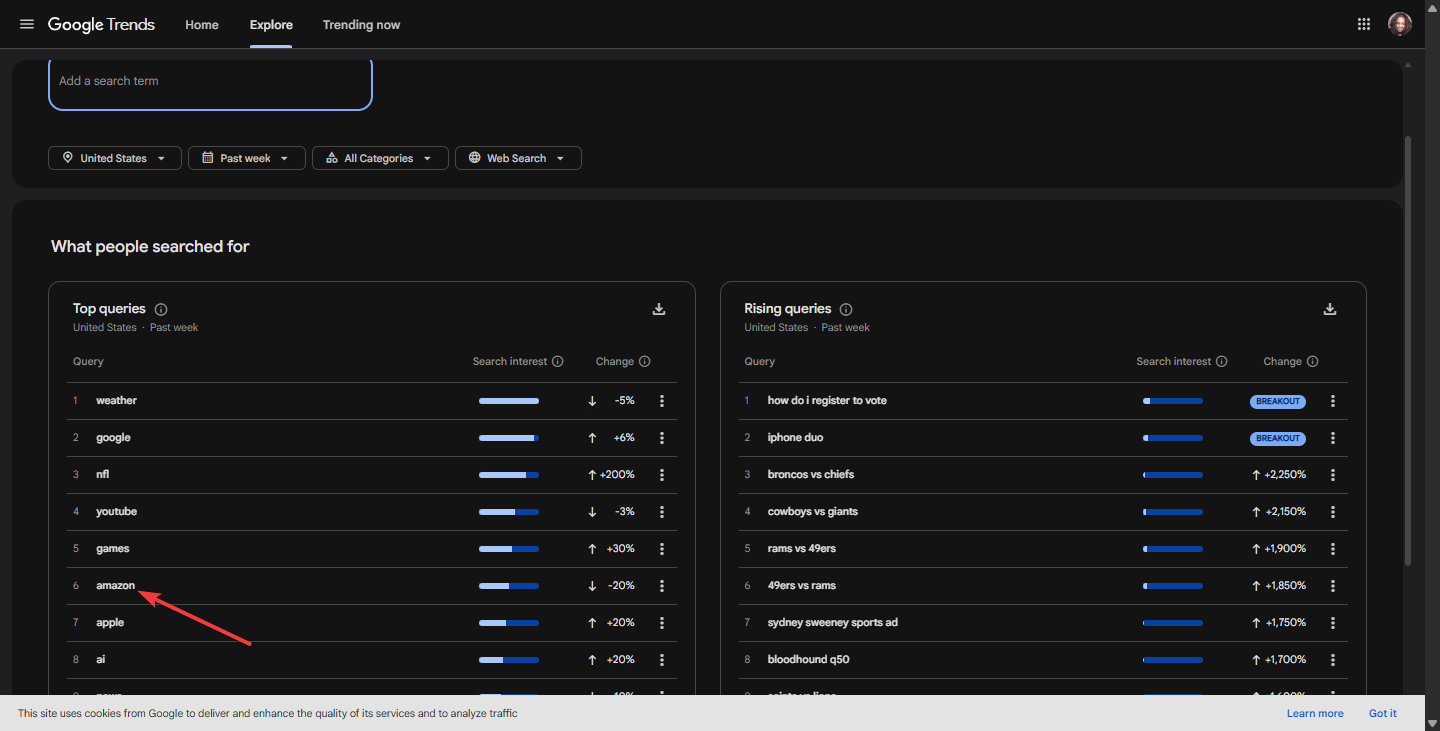
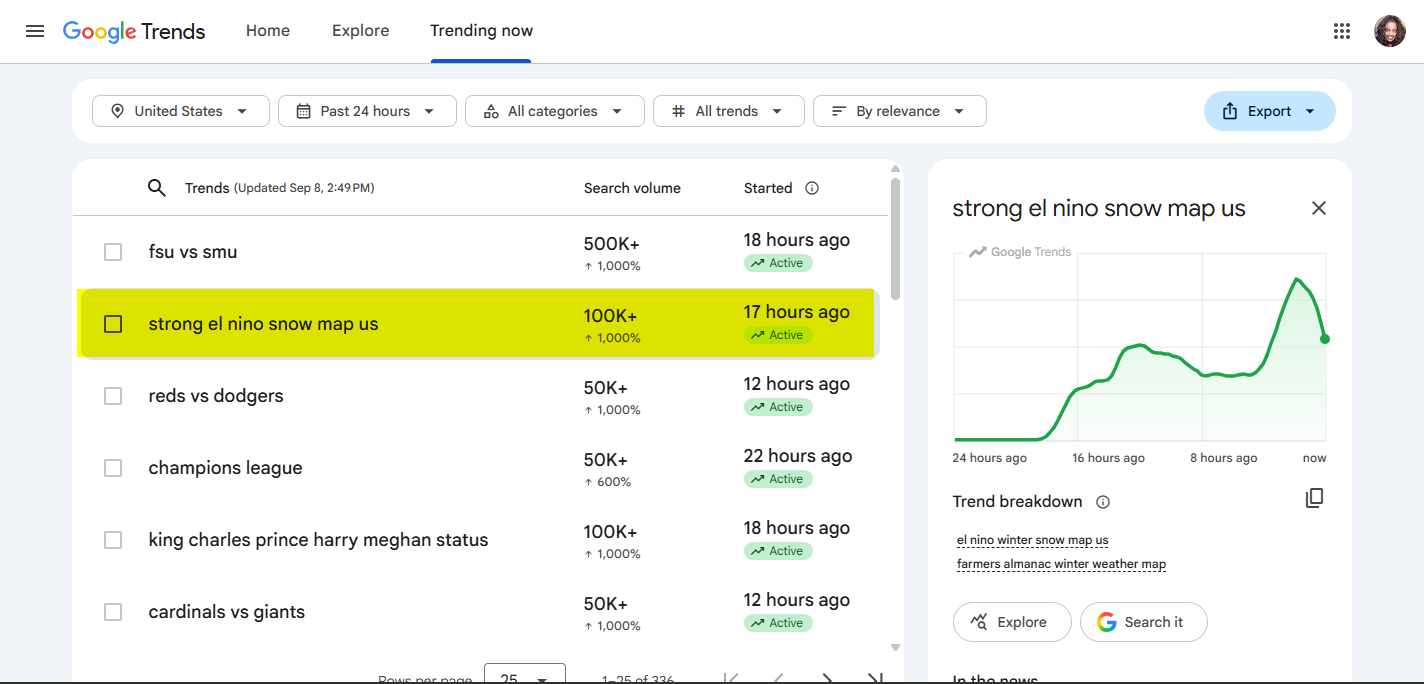
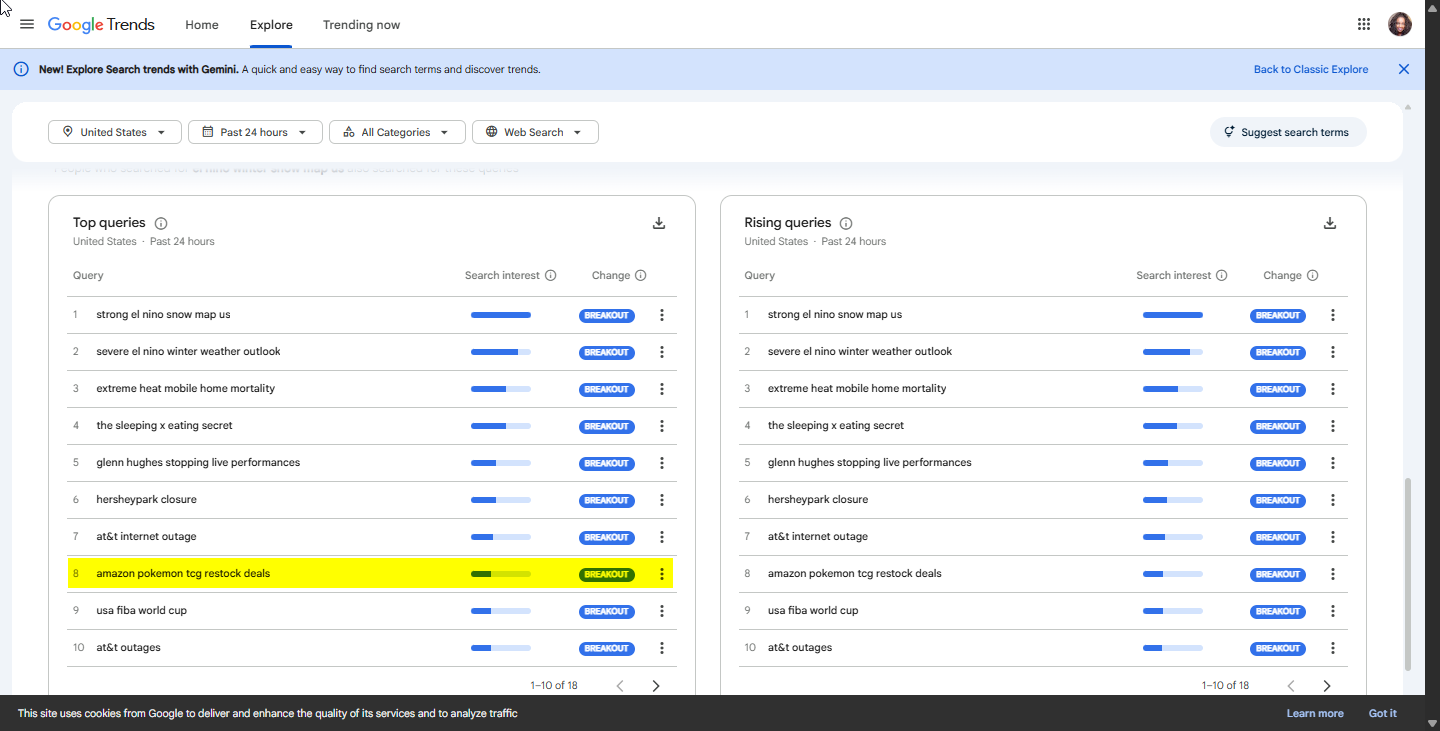
Google Trends told me that Amazon Pokémon TCG was a breakout query while El Niño-related snow searches were also surging. The two looked connected: bad weather keeps people indoors, and card games are an indoor product. It was a tidy story. It also turned out to be wrong. How it fell apart is the more useful lesson than the trend itself. I went down the rabbit hole and pulled the initial data on September 8 and follow-up on September 16th 2026 with the region set to United States, time-frame as the past 24 hours and kept the category and search type unchanged.

The Claim

Off the bat, when I open Google Trends, I’ll find a list of trending topics. At this time, strong el nino snow map us was among the top search queries. Say my trending product is likely to fall in the same category.

In this particular situation, that points to a card game; the Amazon Pokémon TCG. The predicted weather change provides a plausible explanation for why an indoor entertainment product might suddenly attract attention. Google Trends surfaced it as a breakout query. But a breakout label alone doesn’t tell you whether it’s worth betting inventory on.

How Easy It Is to Misread a Google Trends Spike

As a seller, your first assignment is to determine whether the trending product has enough staying power. Just how much are the searchers who could turn into potential buyers showing interest in this product? A short window plus a believable explanation is often enough to make a spike feel confirmed, even when nothing about it has been checked against history.

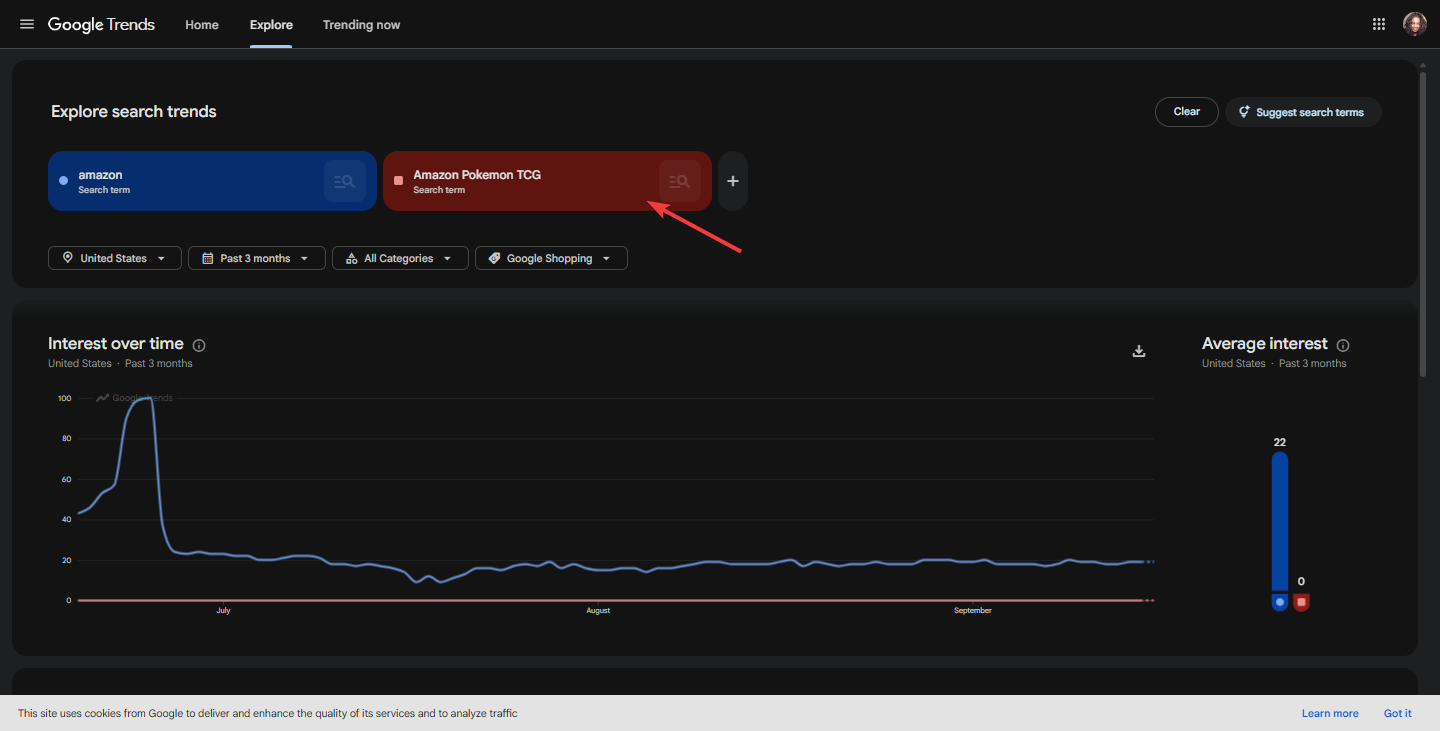
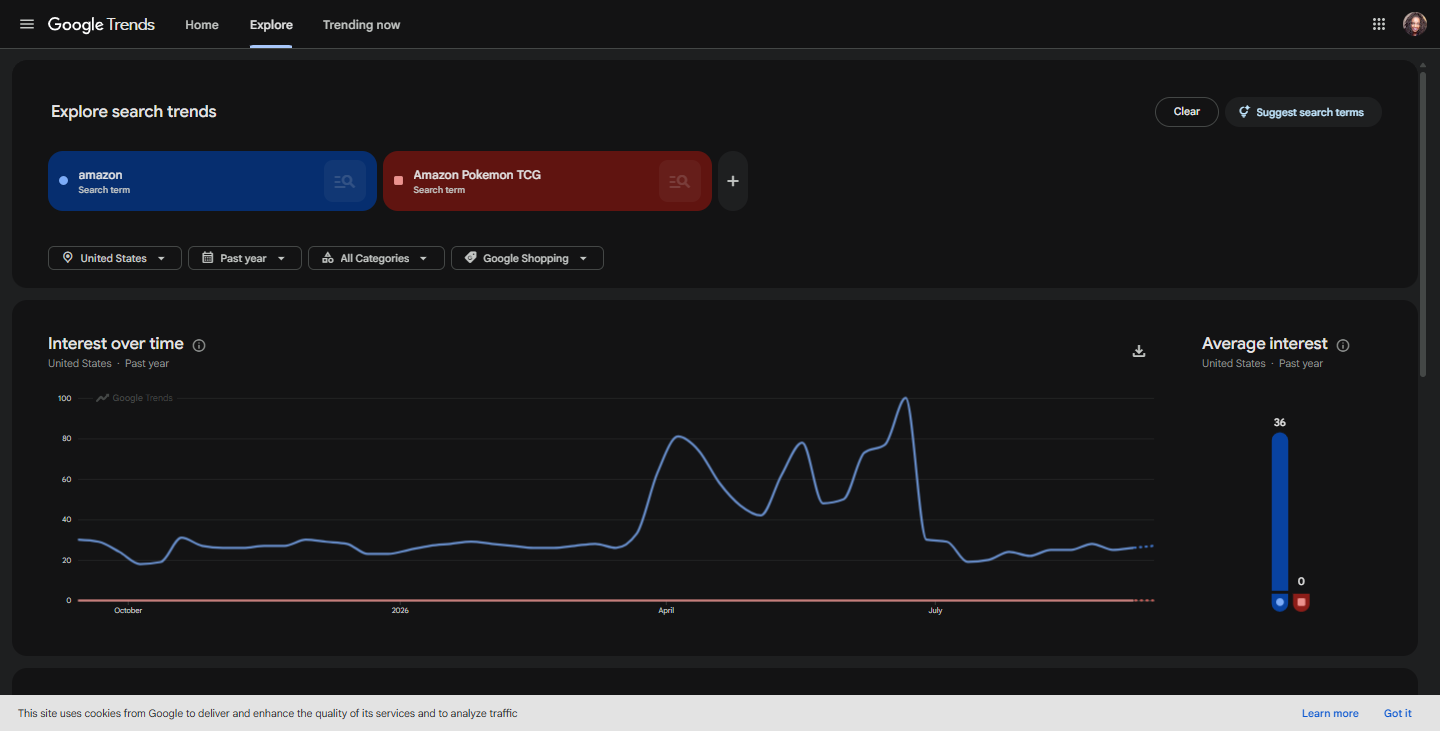
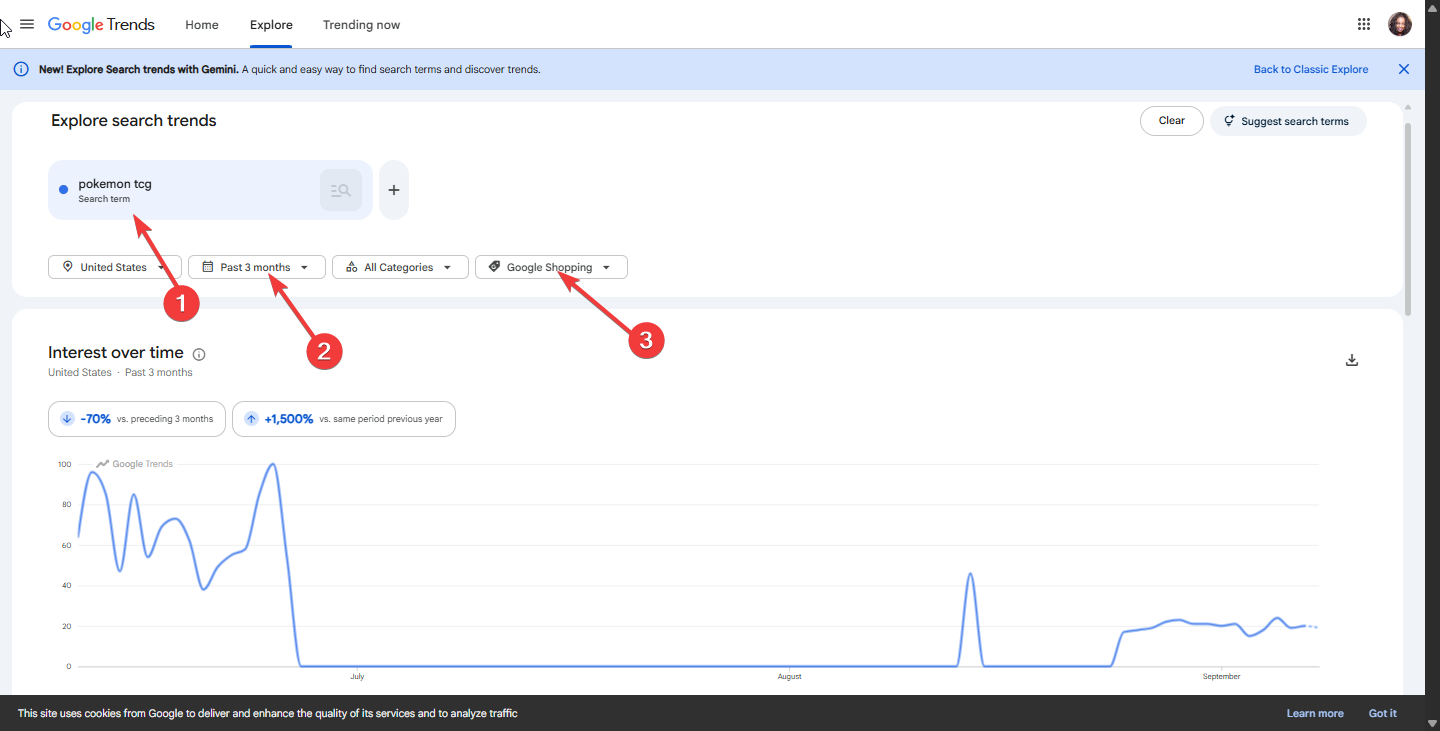
I put the claim to test and compared interest for the Amazon Pokemon TCG across four windows: past month, past 3 months, past year, and past 5 years. I also adjusted the search type to Google Shopping because I wanted to see if it would translate to a more commercially oriented search signal, or if they were just searching out of general curiosity. Differentiating general interest form intent-to-buy isolates true consumer demand from casual interest.

The short windows were convincing. The one-month view showed a sharp, clean spike. Impressive enough that makes it worth stocking inventory for. The three-month view still showed real activity. But the one-year view flattened into a near-flat line, and the five-year view showed no meaningful historical baseline.

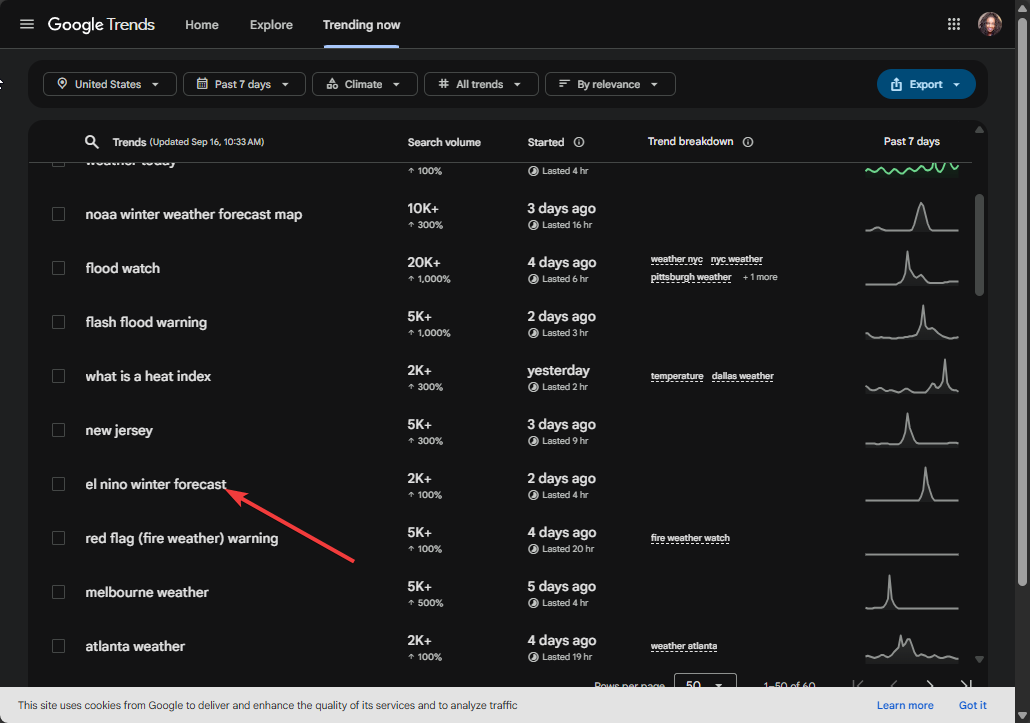
A week later, on September 16, I ran the same check. The weather query itself had already shifted from strong el nino snow map us to el nino winter forecast. The breakout query, Amazon Pokémon TCG had dropped out of the trending list entirely.

Amazon Pokemon TCG was not among the trending queries but Amazon was.

I went ahead to explore the search query with a small adjustment by adding the game to the search query alongside Amazon. It wasn’t among the breakout queries and upon further examination, its search interest had slowed down.

The three-month Shopping-filtered view showed a spike that peaked quickly and then flattened, rather than building into anything sustained.

The one-year and five-year views still showed no baseline.

Where I was almost fooled

First off, Google Trends asn’t wrong. The breakout was real. The mistake would have been interpreting “breakout” as proof of a large and sustainable market. While it highlighted a breakout spike, it provided no data on overall market size, commercial intent, or whether the trend had real staying power.

On the 1-month view alone, the game looked like a clean, confident signal. The three-month view almost sealed the deal with some activity. Further, not only was it a breakout query, it had a plausible cause. The weather trend gave me a very convenient explanation for the Pokémon spike, and it became easy to build a story around the data. If I was a seller, I’d have stopped there. I would have read this as validated demand and moved straight to sourcing inventory.

This breakout query paints a different picture from a seasonal product. The trend would be predictable. If this were a genuine seasonal trend, I’d expect to see recurring peaks around the same period each year on the five-year view. That’s exactly why I went back a week later to see if this momentum would hold up and unfortunately, I couldn’t verify a recurring seasonal pattern. The follow-up confirmed the initial momentum had already fizzled out and the longer-term views did not show a meaningful historical baseline.

My Verdict

Based on the numbers, this claim didn’t hold up. The 1-month spike looked strong in isolation. However, a single unconfirmed spike with no five-year track record isn’t evidence of a genuine breakout query. More importantly, Google Trends does not provide absolute numbers or even the search volume. What you get access to is relative peak interest over a time frame. After all, it could be trending because it’s a new game or some controversy around it. I’m glad I waited it out to see how the search query transformed. I used the breakout query as a signal to investigate rather than a green light to buy inventory. My key takeaway is to look beyond the immediate breakout and check longer timeframes. You can avoid the costly trap of misreading search noise for real demand.

The post Google Trends for product research: I almost mistook a spike for real demand appeared first on Search Engine Watch.

Source:: searchenginewatch.com