Archiv für den Monat: Oktober 2026

Google’s September spam update delivers another ranking jolt

Website owners are reporting another burst of ranking changes during Google’s September 2026 spam update, with renewed movement around September 30 and October 1 following earlier disruption.

Barry Schwartz’s Search Engine Roundtable report brings together SEO observations and tracking charts suggesting another wave. Google’s official announcement describes a single global update covering all languages, which began September 24 and could take up to two weeks. Its status dashboard still marked the rollout active on October 2.

The timing follows SEW’s report on the initial release. Google has not announced a separate second update or identified a new policy target for this latest movement.

The rollout makes diagnosis harder

A site that held steady during the opening days can still move later in an unfinished rollout. The renewed observations therefore give affected publishers a useful date to examine, while leaving the cause of an individual site’s loss unresolved.

For a site that fell around September 30, compare the affected pages and queries in Search Console with the earlier rollout period. A decline concentrated in one page type creates a different investigation from a fall across every section. Record deployments and indexing changes alongside those dates so the update’s timing does not erase other possible explanations.

Ranking charts can show when visibility changed. Diagnosing a spam-policy problem requires evidence from the affected site, rather than treating every downward line during the rollout as a policy verdict.

The post Google’s September spam update delivers another ranking jolt appeared first on Search Engine Watch.

Source:: searchenginewatch.com
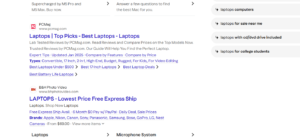
Yahoo sponsored results now showing more blue hyperlinks

yahoo more blue links in ads

Yahoo sponsored results are now showing more blue hyperlinks within ads. I spotted this today while searching for something. I remember the last time I visited Yahoo, ads had fewer blue hyperlinks, but today, they’re showing noticeably more.

Here is the screenshot of this.

more blue link in yahoo ads

Personally, I’m not a fan of this. Showing more blue hyperlinks within ads doesn’t look particularly clean from a design standpoint.

Image credit: commons

The post Yahoo sponsored results now showing more blue hyperlinks appeared first on Search Engine Watch.

Source:: searchenginewatch.com
ChatGPT now lets you try on clothes with a selfie

ChatGPT is adding virtual try-on for clothing and accessories, letting shoppers use a selfie to generate an image of how a product could look on them.

OpenAI’s October 1 release notes describe a “Try on” button on product listings. Selecting it lets users take or upload a selfie, which ChatGPT Images uses to create the preview. The shopping features are available on mobile and the web.

ChatGPT keeps the reference photo for another visit

The photo is saved for future try-ons. Users can change or delete it under Settings, Personalization, then Reference photos.

OpenAI also added product Favorites and folders for organizing saved finds in ChatGPT Library. Its announcement does not specify plan or country restrictions, or give sizing-accuracy and sales-conversion results.

More of the browsing happens inside ChatGPT

Trying a look and keeping a shortlist give shoppers reasons to continue browsing inside the assistant before visiting a retailer. The saved reference photo makes returning to the same activity easier.

For merchants, that puts more of the comparison stage in an interface they do not operate. Measuring visitors arriving from ChatGPT captures the later referral, while leaving the earlier previews and saved products outside that view unless the platform supplies reporting.

SEW has also covered ChatGPT’s product carousel ad tests. The try-on announcement describes a shopping capability without saying that it is restricted to sponsored listings.

The post ChatGPT now lets you try on clothes with a selfie appeared first on Search Engine Watch.

Source:: searchenginewatch.com

Publishers want Congress to stop AI bots pretending to be human

US publishers are pressing Congress to pass legislation targeting bots that hide their identity while collecting website content for AI.

More than 300 publishing executives were expected to take part in a Washington lobbying trip on September 29, Digiday reported. Participants included leaders from Condé Nast, Hearst, USA Today Co. and The Seattle Times.

The bill would make crawlers disclose their intended use

The Stealth Bot Prohibition Act, H.R. 9915, was introduced on July 23. Its definition of a stealth bot covers failure to disclose identity and purpose, including proposed uses such as search indexing, AI training and retrieval augmented generation.

The proposed prohibitions cover deploying stealth bots in ways reasonably likely to damage, impair or burden a service’s technical or commercial operation, and intentionally disguising bots as human users for generative AI purposes.

The text would allow the FTC to seek penalties of up to $53,000 per violation, subject to inflation adjustments, and provides for state enforcement. It remains a proposal.

A crawler’s purpose affects what a publisher can permit

Identification becomes more useful when it includes the intended use of the material. A publisher may welcome search referrals while refusing model training. An accurate bot name alone gives little control if the operator does not explain which activity the request supports.

SEW’s recent examination of Cloudflare’s crawler controls explains how search and training permissions differ across providers. Those controls also rely on identifying the request and, for robots.txt, the crawler cooperating.

Digiday reports that publishers see disclosure as a step toward blocking unwanted access and negotiating licenses. The bill itself establishes neither a standard licensing price nor an automatic payment obligation for scraping.

The post Publishers want Congress to stop AI bots pretending to be human appeared first on Search Engine Watch.

Source:: searchenginewatch.com

AI shopping answers keep sending customers to the big chains, study finds

ChatGPT and Google’s AI shopping answers favor major retailers, including when they find smaller stores on the web, according to research by Vaer AI commissioned by commerce software company Lightspeed.

The study analyzed roughly 460,000 responses. With live search enabled, large chains took 46% to 58% of the top recommendations across the tested platforms. Smaller stores were more competitive among the linked sources, where large and small retailers each accounted for roughly 38%.

A citation can leave a shop behind the recommended chain

Vaer’s published example shows ChatGPT citing three small stationery shops among six sources while recommending Staples first. Across the study, large chains became the lead recommendation about 2.5 times as often as small stores.

That is a useful distinction for retailers buying AI visibility reports. A tool counting citations can record exposure even when the answer directs the shopper toward a competitor. Retail teams need to know which outcome a reported improvement measures before assigning it commercial value.

The headline figures cover different tests

The widely reported 90% to 94% preference for bigger retailers came from head-to-head tests with web search switched off. The live-search findings cover a different condition, closer to how shoppers use AI search.

Lightspeed’s methodology summary describes 20,000 prompts spanning ten categories in Los Angeles, San Francisco, New York and Montreal. Analysis ran from June to August 2026. The headline results should be read within that geographic and testing scope.

Asking for independent stores changed the results

A follow-up found that adding “independent” to shopping prompts increased the small and local shops named from roughly one-third to nearly four-fifths. Asking for “local” had a weaker effect, since a nearby branch of a chain could satisfy that request.

The study’s full technical report is available on request. Lightspeed sells retail software and is using the findings in an AI visibility campaign. Neither public summary reports purchases generated by the recommendations.

SEW previously covered John Lewis’s investment in product videos aimed at AI discovery, an example of the resources a large retailer can put into this channel.

The post AI shopping answers keep sending customers to the big chains, study finds appeared first on Search Engine Watch.

Source:: searchenginewatch.com