Kategorie-Archiv: SEO

Bing tests new ad design within SERP

bing short ad

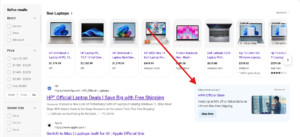
Bing is testing a new design for ads within its SERP. Previously, these ads appeared differently, but now Bing seems to be testing a new layout featuring a blue background box with the favicon, title, URL, and a short description.

Here is a screenshot of this.

Personally, I like this design. I hadn’t seen it before, so I’m assuming this is a new test, though I could be wrong.

The post Bing tests new ad design within SERP appeared first on Search Engine Watch.

Source:: searchenginewatch.com

Shopify opens checkout to AI shopping agents

Shopify has added tools that let AI agents read and update a shopper’s checkout, then submit the order after the buyer confirms the purchase. The change extends its browser-based shopping tools through checkout and order confirmation.Announced on recently, the update works inside the buyer’s active browser session. Shopify says merchants do not need to configure the checkout tools, which use the same state as the checkout interface the shopper sees.

What an agent can do at checkout

The four tools cover returning to the storefront, reading checkout information, updating supported fields and submitting the purchase. An agent can also retrieve order details after checkout is complete.

Shopify’s documentation describes updates to contact details, shipping choices, discount codes and supported payment selections. The tools cannot accept new card details. Payment flows include saved Shop Pay cards and Shop Pay approvals, while shoppers handle other payment methods on the checkout page.

Before submitting an order, the agent must show the buyer the current order and total and obtain permission. If the total changes, it must ask again. Authentication steps such as 3D Secure, and checkout extensions that require buyer interaction, return control to the shopper.

WebMCP gives agents specific actions to call

WebMCP lets a webpage expose structured tools to a browser agent. That gives the assistant defined actions, rather than requiring it to work out which buttons and fields to use from the page.

Google opened a WebMCP origin trial in Chrome 149 in June. Origin trials let developers test experimental browser features with live applications; the underlying APIs remain subject to development.

Shopify’s August 5 storefront announcement already covered product searches, cart changes and navigation to checkout. It described availability on Liquid storefronts and the Hydrogen developer preview, with agent support limited to Chromium-based browsers through an origin trial.

The September addition supplies tools for working within checkout itself. Actual use still depends on an agent and browser that support WebMCP.

Our take: agent-assisted purchases can stay on the store

For merchants, the important design choice is where the transaction happens. The assistant acts on the checkout already open in the shopper’s tab, with the buyer able to see the order and take over when necessary.

That offers another route alongside the native checkout experience SEW recently covered on Google, where eligible purchases can happen within Google. Shopify’s browser tools let an assistant help finish a purchase on the merchant’s existing checkout page.

Agent developers still need to consider access. Shopify recommends signing browser requests with Web Bot Auth and registering the agent’s keys; requests without it may be deprioritized or blocked by bot detection.

Shopify has documented the transaction mechanism, but its announcement includes no adoption figures or conversion results.

The post Shopify opens checkout to AI shopping agents appeared first on Search Engine Watch.

Source:: searchenginewatch.com

Google, Booking.com and Expedia unveil a draft rulebook for AI hotel bookings

The Universal Commerce Protocol (UCP) project has released its first lodging booking draft, with Google, Booking.com, Expedia and major hotel groups helping shape a common specification for AI-assisted reservations.

The September 25 announcement says the draft has been merged into the project’s repository and opened for public feedback. It credits a Lodging Tech Council including Amadeus, Booking.com, Expedia, Google, Hilton, Marriott and Trip.com.

The documentation remains a work in progress, with potentially breaking changes ahead.

What happens after an assistant finds a room

The booking capability takes property and rate identifiers from an earlier search process. The business then checks inventory, calculates binding prices and attaches cancellation terms. A confirmed reservation is created when the booking session is completed.

That adds technical detail to the plans SEW previously covered for hotel bookings within Google Search. This release opens the shared specification to scrutiny; the announcement provides no consumer rollout date.

The business remains the merchant of record. Unless the AP2 Mandates extension is supported, the user must finalize the booking manually through a trusted interface.

The full price and the payment schedule

The lodging draft requires the full stay liability to be presented before confirmation, including mandatory charges collected at the property. Stay totals cover the entire duration rather than a single night.

The separate Payment Terms extension represents what is owed and when through payment schedules. Its documentation gives lodging as an example: a business can offer full payment at booking or a first-night payment followed by the balance at check-in.

Each schedule needs a buyer-facing description of when and how payment is due. If selecting a term changes the total, the returned checkout must reflect the change and the platform must display the updated response.

For a traveler comparing rates, the amount collected today can therefore be shown alongside the complete financial commitment.

Developers are asking about failed requests and changed terms

In the announcement’s replies, contributor KukretiShubham asks how implementations should avoid two reservations when an API completion request times out and the customer finishes the same session through a website.

The contributor also asks how earlier approval should be invalidated if a refundable room becomes non-refundable, or payment switches from later to immediate, while the total stays unchanged.

These are requests for clarification and worked examples in the public discussion. The thread supplies no demonstration of a duplicate reservation occurring.

The AP2 Mandates documentation describes signed proof that a user authorized a specific checkout state and funds transfer. That binds authorization to the terms being approved. The contributor is asking for a lodging-specific example of how a changed policy should trigger renewed approval.

Our take

The same room at the same price can represent a different purchase when its cancellation terms or payment date change. Those details affect what a hotel can promise in an offer and what the guest ultimately agrees to buy.

The public draft gives hotel booking providers a concrete basis for reviewing that handoff. The most useful implementation evidence will be how systems preserve the approved rate and recover a reservation’s outcome when completion is delayed.

The post Google, Booking.com and Expedia unveil a draft rulebook for AI hotel bookings appeared first on Search Engine Watch.

Source:: searchenginewatch.com
Google turns Gemini in Chrome into a billboard on Chrome Web Store

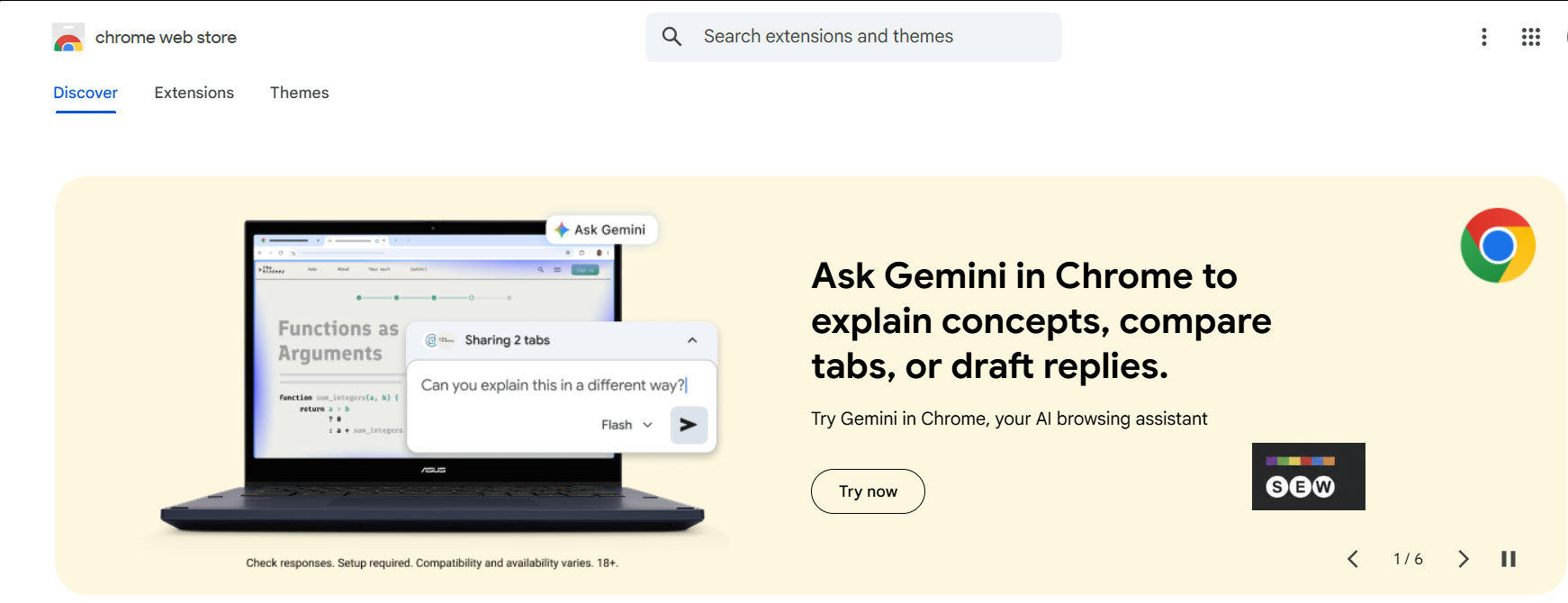
Google has been actively promoting Gemini in Chrome since the AI assistant began rolling out to users. Now, the company is using the Chrome Web Store homepage to put the tool in front of even more users.

The promotion appears as the first slide in the site’s rotating carousel. It features the Chrome logo next to a callout that reads:
“Ask Gemini in Chrome to explain concepts, compare tabs, or draft replies.”

The banner describes Gemini in Chrome as “your AI browsing assistant” and includes a “Try now” button. Google is highlighting three everyday use cases: explaining concepts, comparing multiple open tabs, and drafting replies. The copy also makes it clear that Gemini is part of Chrome itself, rather than a separate extension users need to install.

Image Credit: Venkat | Search Engine Watch

Clicking “Try now” takes users directly to Google’s Gemini in Chrome landing page. The destination URL includes utm_source=owned, utm_medium=chrome-web-store and utm_campaign=GiC-promo, indicating that Google is tracking the Chrome Web Store as a distinct promotional source for the feature.

We spotted the banner while visiting the Chrome Web Store from another browser, such as Opera.

Google’s Gemini in Chrome page currently highlights features such as asking questions about webpages, comparing information across open tabs, summarizing content and YouTube videos, and using Gemini alongside other Google products.

The Chrome Web Store promotion therefore appears to be another way for Google to push Gemini in Chrome directly to people browsing its extension marketplace.

The post Google turns Gemini in Chrome into a billboard on Chrome Web Store appeared first on Search Engine Watch.

Source:: searchenginewatch.com
Google tests new review treatments within sponsored results

new review treatments within sponsored results

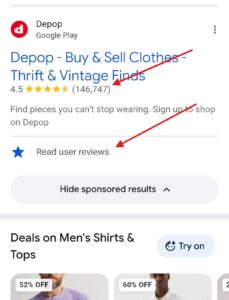
Google is testing new ways to display website reviews within sponsored results. Today, we spotted two variations.

In the first, Google shows the website’s review rating alongside the website name directly within the ad.

Here is a screenshot of this.

In the second variation, the total review count and rating appear below the ad’s title, along with a “Read user reviews” sitelink.

Here is a screenshot of this.

new review treatments within sponsored results-1

This is a positive change for websites with strong ratings, since prominently displaying reviews like this could help build user trust and potentially increase click-through rates.

The post Google tests new review treatments within sponsored results appeared first on Search Engine Watch.

Source:: searchenginewatch.com