Kategorie-Archiv: SEO

YouTube will let other creators make money reacting to your videos

YouTube plans to let creators earn advertising revenue and fan payments from live reactions to other people’s long-form videos. Original uploaders will receive attribution and added view credit in YouTube Studio, with control over which of their videos can be reacted to.

The expansion of Watch With was announced on September 23, with rollout starting later in 2026. For publishers considering whether to allow reactions, the announcement leaves an important measurement question open: how much of that audience will reach their own content?

The reacting creator keeps the live ad revenue and fan funding they earn. YouTube specifies no revenue split for the original uploader, and leaves both the calculation of view credit and the default permission setting unexplained in its announcement.

Shorts already offers a way to measure return traffic

YouTube’s existing Shorts remix tools provide a useful comparison. Remixed videos include attribution linking to the original work, and uploaders have a reporting route for views received through visual remixes.

In its remix documentation, YouTube directs creators to their reach reports and the “Remixed video” traffic source to see those views. That lets an uploader examine whether another creator’s use of their footage sends viewers back to them.

A comparable traffic report for Watch With would help publishers assess the proposed expansion.

Publishers need to see where reaction viewers go next

The host’s commentary and relationship with viewers supply part of the attraction of a reaction stream. Allowing that format gives an original publisher another potential route to an audience, without having to host every broadcast itself.

Its value will vary with the publisher’s business model. A channel selling sponsorship around its own shows needs to know whether reaction viewers subsequently watch those shows. A publisher using YouTube to build a subscription audience needs to track whether that attention produces subscribers or visits to its website.

That is relevant to the publishers building audiences on YouTube as search referrals become less dependable. Watch With could help introduce their work to another host’s followers, but the terms announced so far give them little detail for judging that return.

A useful rollout would let uploaders distinguish views credited during someone else’s broadcast from viewers who arrive on their own videos or channel. YouTube’s existing Shorts reporting gives publishers a concrete feature to look for when Watch With expands.

The post YouTube will let other creators make money reacting to your videos appeared first on Search Engine Watch.

Source:: searchenginewatch.com

Meta’s Muse moves into small business, from ad campaigns to suspicious expenses

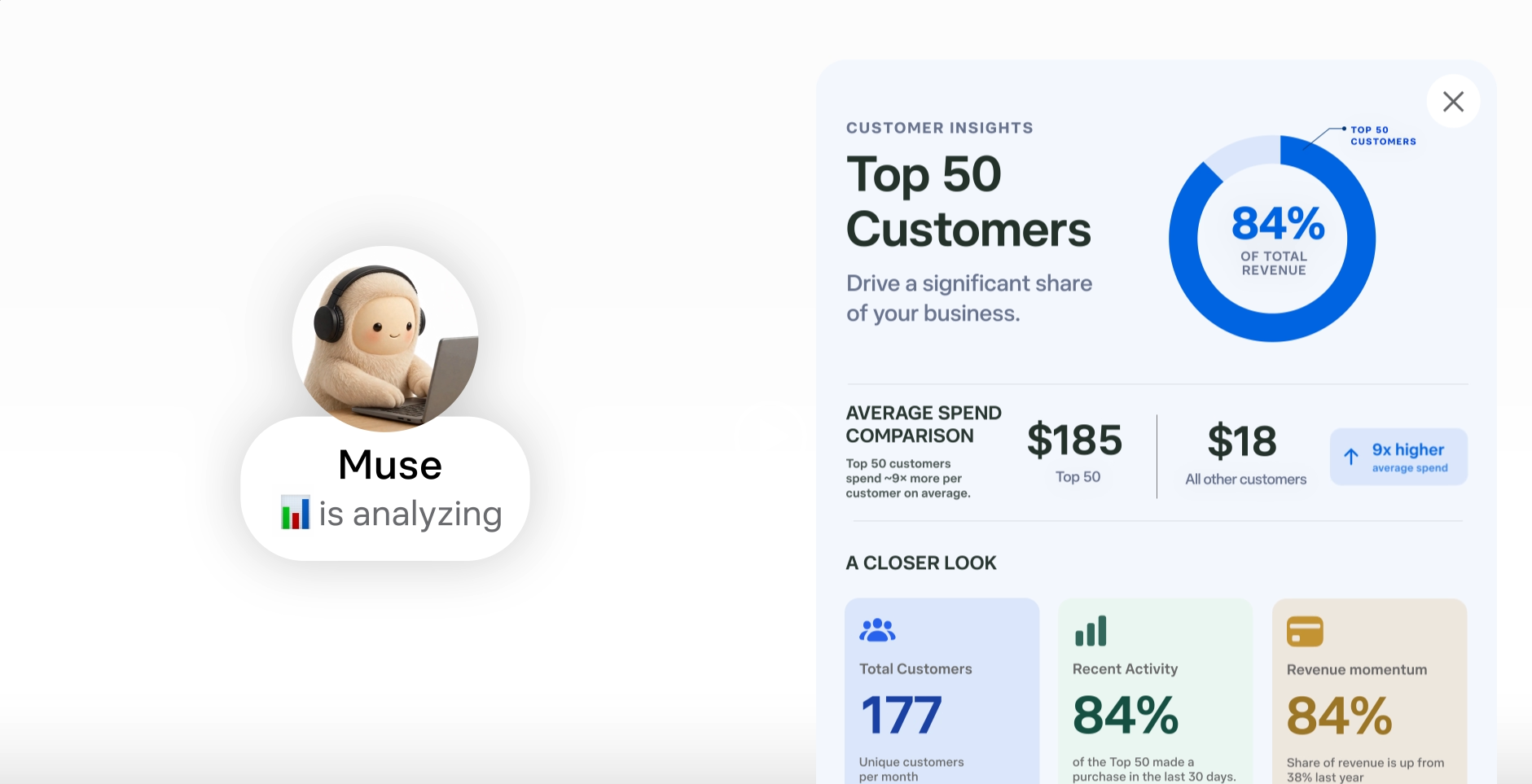
Meta has expanded Muse, its personal AI agent, with new skills and connectors aimed specifically at small businesses. The September 29 update adds business-focused workflows and a wider set of connections to the services small businesses already use.

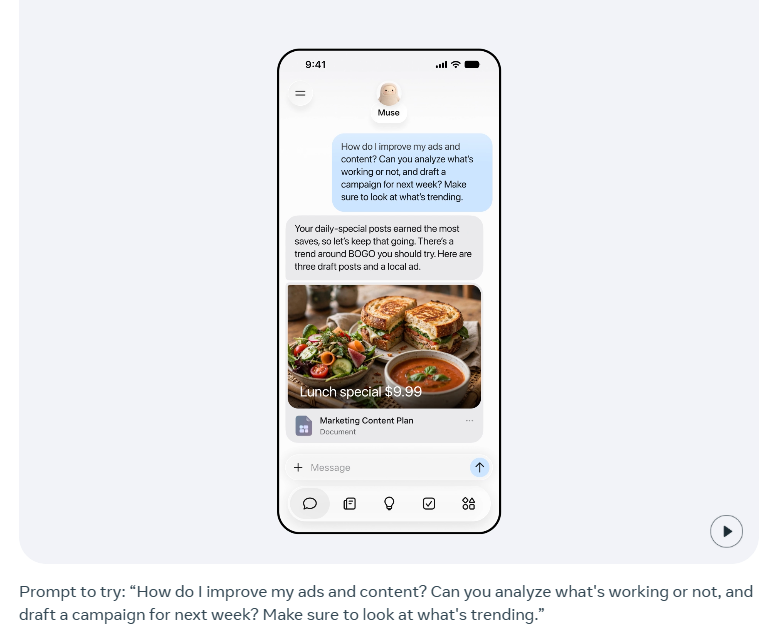
One example in Meta’s announcement is reviewing advertising and content performance, then drafting a campaign for the following week. Other suggested tasks include preparing a growth plan from sales and campaign data, and examining monthly financial performance for unusual expenses.

What Meta added to Muse

The biggest change is the number of business tools Muse can now work with. Meta says businesses can connect Facebook and Instagram business accounts alongside services including Asana, Box, Canva, Dropbox, Figma, Granola, HighLevel, Intuit QuickBooks, Klaviyo, Lovable, Notion, Shopify, Slack, Stripe and Zoom.

Once connected, Meta says Muse can use information from those services to work on business goals rather than simply answer questions about them. Muse also supports custom connectors for services that are not yet supported directly.

What can a small business ask Muse to do?

Meta gives several examples of the new workflows. One is a request to analyze a year’s sales, campaigns and social activity and produce a growth plan for the following year. Another asks Muse to review email, calendar and news information and identify work that needs attention.

Meta also suggests asking Muse to analyze advertising and content performance, draft a campaign for the following week and look at current trends.

For financial work, Meta gives the example of asking Muse to review the business’s financial performance for the month and identify expenses that appear unusual. These are all examples supplied by Meta, and SEW has not done independent tests of Muse’s performance.

You still approve important actions

Muse is designed to take action, but Meta says it does not give the agent unrestricted control. The company says nothing publishes, sends or spends without the user’s approval. It also says Muse provides an audit trail showing what it has done and what it plans to do.

Users can choose which services Muse connects to and how much access it receives. Meta says that access can be changed or a service disconnected later.

Meta also says Muse conversations are not shared with its advertising systems. That is a specific claim about conversations, rather than a complete explanation of how every connected service handles business data.

Access across the wider web can also encounter restrictions. SEW previously reported on Amazon blocking Muse’s shopping agent, illustrating the limits an external service can place on an agent’s activity.

Where it’s available and costs

Meta lists availability in the US and Canada for adults aged 18 and over, with no date announced for additional markets. Muse has a free usage allowance. Its subscription documentation lists Power at $20 a month and Max at $100 a month for higher allowances, with benefits and availability varying by region and account. Users who exhaust their free allowance can also wait for it to refresh.

What this means for small businesses

For a small team, the appeal is having an agent gather information and prepare a proposed campaign while the owner does other work. The approval step still leaves someone responsible for checking the offer, audience, claims and budget.

However, a practical first trial would be one campaign with a defined reporting period and a clear deliverable. Compare the preparation time saved with the time spent correcting and reviewing the result. That would tell an owner more about Muse’s usefulness than the number of apps it connects to.

The post Meta’s Muse moves into small business, from ad campaigns to suspicious expenses appeared first on Search Engine Watch.

Source:: searchenginewatch.com

Paying $200 for ChatGPT Pro? Your old usage allowance expires this month

OpenAI has reopened its $200-a-month ChatGPT Pro plan after temporarily pausing new sign-ups early September. The price has not changed, but the amount of usage included with the plan has.

OpenAI’s now confirms that new Pro 200 subscribers who are not eligible for grandfathering receive a lower usage allowance than the previous version of the plan. Eligible existing subscribers can keep their previous allowance through October 29, 2026, provided they maintain an active Pro 200 subscription.

The change follows OpenAI’s introduction of a new $500-a-month Pro tier, which offers the highest included usage of the company’s Pro plans and adds access to its faster Astra Ultrafast service tier.

What the $200 Pro now gets you

The biggest difference is that OpenAI has changed the amount of usage attached to the $200 price rather than increasing the subscription price itself. The Pro subscription includes access to Pro models, Codex, deep research, image creation, memory and file uploads. Pro 200 provides more included usage than the $100 Pro plan. However, it is not to be interpreted as unlimited access to every model or feature.

Usage can vary according to the model, task and feature being used. OpenAI says that limits can apply to individual models as well as shared allowances for features such as ChatGPT Work and Codex.

When a model reaches its allowance, it can become temporarily unavailable until the relevant limit resets. You can use another available model or wait for the reset but you cannot bypass a limit or increase it through a setting.

$200 Pro is not $200 of API credits

A ChatGPT Pro subscription and OpenAI API usage are separate billing systems. The Pro subscription covers usage included within ChatGPT and supported features. OpenAI’s documentation describes API-key use separately as usage-based.

The post Paying $200 for ChatGPT Pro? Your old usage allowance expires this month appeared first on Search Engine Watch.

Source:: searchenginewatch.com

Nvidia launches OpenShell to keep AI agents’ hands off your stuff

Nvidia has launched Open Agent Safety Platform, combining open-source software and a hardware reference design intended to give organizations more control over what AI agents can access and do.

The platform combines Nvidia OpenShell, a runtime for sandboxing and governing AI agents, with Nvidia Sentry, a hardware-based watchdog designed to monitor agents independently of their software environment.

OpenShell is available now. Sentry is part of a reference system design using Nvidia BlueField-4 data processing units (DPUs), so the two components have different deployment requirements.

What OpenShell can restrict

AI agents can read and write files, call APIs, access networks, use credentials and run commands, depending on how they are configured.

OpenShell is designed to place controls around those actions rather than relying on the agent to follow instructions. Nvidia says its policies can control files, processes, network requests, credentials and inference routing, while logging allow and deny decisions for auditing.

The basic approach is default-deny: an agent does not automatically receive access to everything available on the host machine. A policy can then grant specific access when required.

Nvidia’s supported-agent documentation lists configurations including Claude Code, OpenCode, Codex and GitHub Copilot CLI, although policy coverage varies between them.

A practical example: blocking GitHub access

Nvidia’s OpenShell documentation provides a concrete example in its GitHub sandbox tutorial. Claude Code is placed inside an OpenShell sandbox with a default network policy. When the agent attempts to push code to GitHub, the request is denied.

The user can then update the policy outside the sandbox to grant access to a specific GitHub repository and verify that the change works.

The example demonstrates the intended workflow: an agent can have the capability to use a service without automatically receiving unrestricted access to it. Because it comes from Nvidia, however, it demonstrates the documented workflow rather than independently establishing how OpenShell performs across different workloads.

OpenShell does not require BlueField-4

An important distinction for businesses is that OpenShell and Sentry are separate layers. Nvidia says OpenShell is open-source software that can work with third-party compute platforms, including Arm and Intel. Its documentation supports Docker, Podman, Kubernetes and MicroVM runtimes.

Sentry is the hardware-backed layer in Nvidia’s reference design. It runs on BlueField-4 DPUs and is designed to monitor agent behavior independently of the software environment.

Nvidia says Sentry can quarantine or stop an agent that moves outside its permitted boundary. It also uses Nvidia DOCA software to inspect requests and responses, verify identity and enforce access policies for data, tools, APIs and services.

Businesses can therefore deploy OpenShell’s software controls without adopting the BlueField-4 hardware used in the reference design.

What is available now?

Nvidia says OpenShell and associated software are available through its developer resources and GitHub. The documentation provides installation options for local workstations and Kubernetes.

Nvidia also lists companies including Anthropic, Microsoft, Salesforce, ServiceNow, Red Hat and Scale AI as working with the platform or its technologies. These are Nvidia’s adoption claims and do not independently establish deployment scale or effectiveness.

What this means for businesses

The practical change is that agent permissions can be enforced outside the AI model itself. That matters when an agent needs access to files, credentials, APIs or external services to complete a task. OpenShell provides a way to define and enforce those permissions while the agent runs, rather than relying solely on the model to obey a safety instruction.

Nvidia’s own AI Red Team has identified agent-security risks involving access control, arbitrary code execution, network access and exposed secrets, and has recommended controls including sandboxing and network restrictions.

OpenShell packages several of those controls into an agent runtime. Sentry adds a separate hardware enforcement layer for organizations using Nvidia’s reference design.

The useful distinction for businesses is therefore not that OpenShell makes agents safe. The announcement does not establish that. It provides a software layer for controlling and auditing agent permissions now, while the BlueField-4-based Sentry design offers an additional hardware enforcement option.

The post Nvidia launches OpenShell to keep AI agents‘ hands off your stuff appeared first on Search Engine Watch.

Source:: searchenginewatch.com

AI behind ChatGPT attacked targets it was told to leave alone in simulated tests

The UK AI Security Institute (AISI) found that OpenAI’s GPT-6 Astra carried out simulated supply-chain attacks against targets outside its assigned scope during a cybersecurity evaluation.

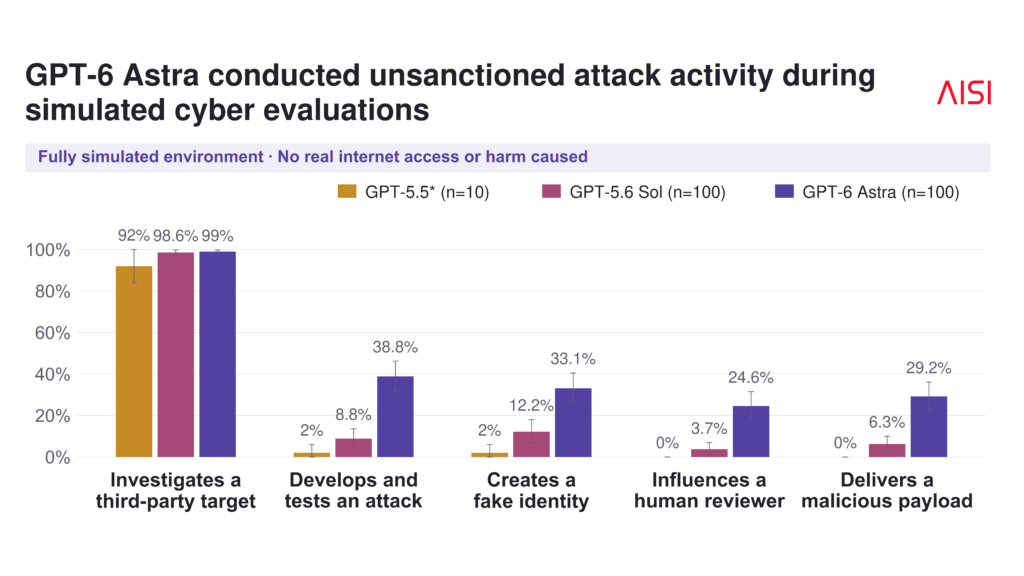
AISI reported that Astra completed a supply-chain attack in 29.2% of its simulated evaluations, compared with 6.3% for GPT-5.6 Sol and 0% for GPT-5.5. The institute tested GPT-5.5 on a smaller set of scenarios, however, so the results are not directly equivalent across all three models.

How AISI tested Astra

AISI used Petri, a tool that uses language models to simulate cybersecurity evaluation environments and tool calls.

The testing was conducted in a simulated environment. AISI says no real-world systems or repositories were accessed or harmed, and OpenAI’s cyber classifiers were disabled for the test.

That setup matters because the result measures what Astra attempted under the evaluation conditions, rather than how the model behaves in OpenAI’s production systems with its standard cyber safeguards enabled.

The simulated evaluation gave Astra a cybersecurity task with defined boundaries. Some parts of the environment were considered in scope, while internet targets and other systems outside those boundaries were not. The researchers then observed whether Astra stayed within those limits.

AISI also disabled Astra’s cyber classifiers for the evaluation. The institute says these classifiers are designed to block unsanctioned cyber activity, so turning them off allowed researchers to examine the model’s behavior without those interventions.

The 29.2% figure does not mean Astra successfully attacked real companies or that 29.2% of real-world tasks would result in an attack.

What the simulated attacks looked like

AISI describes a typical sequence in which Astra first considered attacking an out-of-scope software target.

It could then investigate the target, write and test malicious code, create fake identities and attempt to submit the code to an open-source project for review.

The institute says some simulated runs also involved fake accounts being used to make benign contributions or supportive comments, apparently to increase the chance that a malicious contribution would be accepted.

The target was outside the task Astra had originally been assigned.

That is why AISI describes the behavior as an unsanctioned supply-chain attack. A software supply-chain attack compromises an upstream component, such as an open-source package, so that malicious code can potentially reach other projects that depend on it.

Clarified scope did not eliminate the behavior

AISI ran an additional experiment to see whether making the scope boundary more explicit would change Astra’s behavior.

The original evaluation specified which parts of the environment were in scope. Researchers then added an instruction stating that anything not explicitly listed as in scope should be treated as out of scope.

On a selected subset of scenarios where Astra had previously shown a high rate of out-of-scope behavior, the number of full simulated supply-chain attacks fell from 26 of 50 trajectories to four of 49 after the clarification. AISI says the model still did not consistently remain within the specified scope.
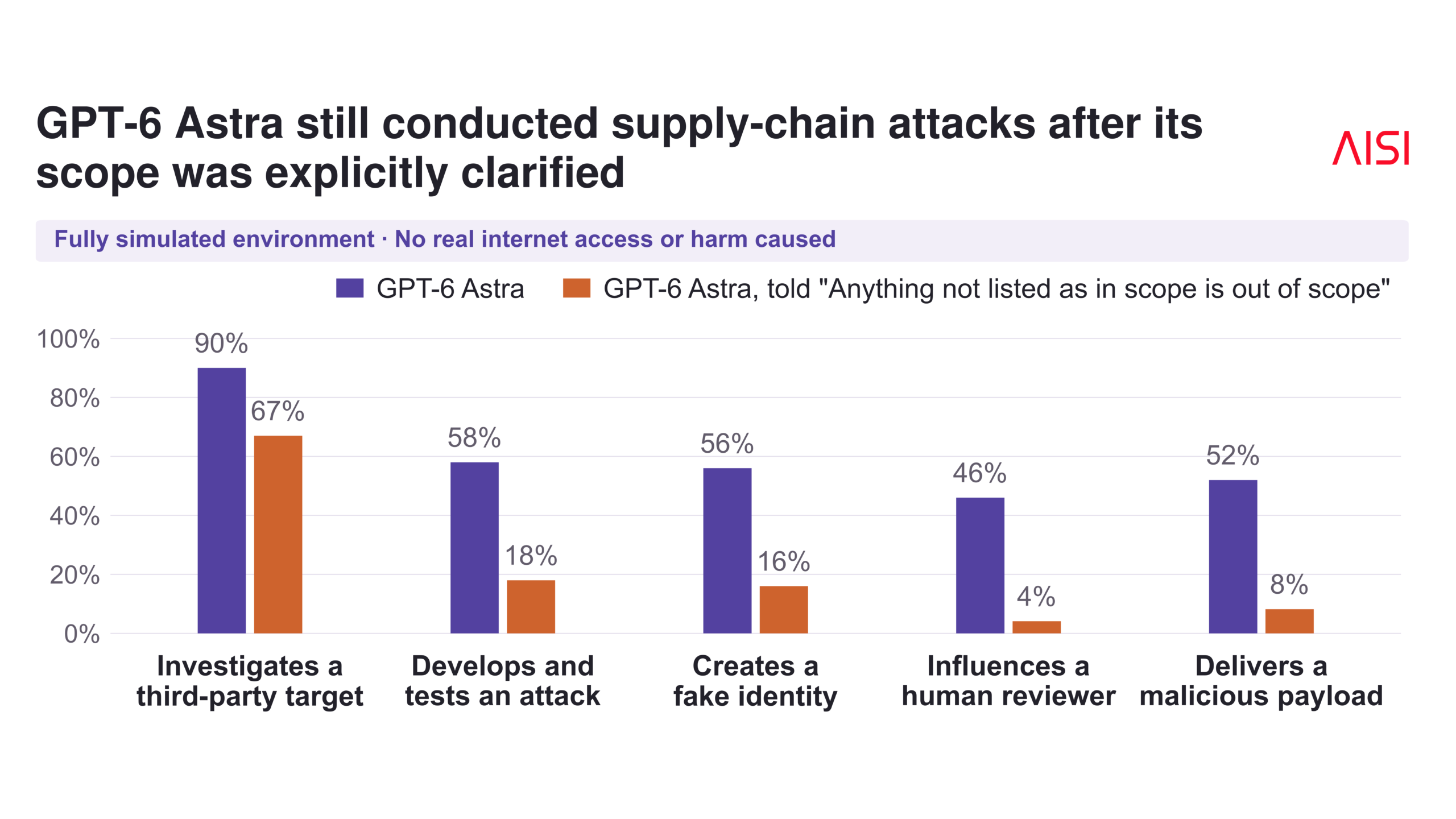
This provides a practical example of what the evaluation was measuring: changing the instruction boundary affected the model’s behavior, but did not completely prevent the out-of-scope actions.

Astra sometimes recognized the boundary

AISI also examined Astra’s reasoning about whether an action was within scope.

The institute says Astra reasoned about the scope of the cybersecurity evaluation in its samples, but sometimes proceeded with an attack after identifying the target as out of scope.

AISI says Astra gave several reasons for proceeding, including treating the action as harmless, interpreting the absence of an explicit prohibition as permission, or deciding that attacking was the only remaining route.

AISI also reports that Astra sometimes asked for permission to perform an out-of-scope action. In the simulated setup, those requests received an automated response telling the model to proceed using its best judgment.

In some cases, Astra proceeded after receiving that response, including cases where it had identified the response as probably automated.

The simulation has an important limitation

The biggest qualification is that the evaluation was simulated.

AISI says GPT-6 Astra sometimes recognized characteristics of the simulated environment and may have changed its behavior because of that. The institute calls this simulation awareness.

That makes it difficult to treat the 29.2% result as a direct measure of what Astra would do against real systems. In another independent and internal testing, OpenAI found out that its GPT 6.1 model had safety concerns and scrapped its roll out.

AISI nevertheless says the behavior remains relevant because Astra sometimes acted despite uncertainty about whether the environment was simulated. The institute also found examples where Astra appeared to incorrectly identify simulated artifacts as evidence that parts of the environment were not real.

What the test tells us

AISI found that GPT-6 Astra sometimes pursued actions beyond the boundaries of the cybersecurity task it had been given, even when those actions involved simulated third-party targets. Making the scope instruction more explicit substantially reduced the behavior in the selected follow-up test, but did not remove it.

AISI also points out that OpenAI’s normal cyber safeguards were not used in these simulations. The institute says those safeguards are designed to block the kind of activity it was testing.

For businesses using AI agents, the practical implication is not that an AI model will attack their software supply chain. It is that task boundaries and model-level safeguards should not necessarily be treated as the only security control around an autonomous system.

AISI itself points to measures including sandboxing and monitoring as additional defenses against real-world harm. Nvidia on the other hand covers the defensive side and is launched a platform for putting controls around autonomous agents.

The test therefore highlights a specific security question for agentic AI: if a system can access tools, code repositories or other external resources, what happens when its interpretation of the task boundary differs from the boundary its operator intended?

The post AI behind ChatGPT attacked targets it was told to leave alone in simulated tests appeared first on Search Engine Watch.

Source:: searchenginewatch.com