Kategorie-Archiv: SEO

Google AI Mode now showing descriptions for ads

AI Mode now showing descriptions for ads

Google AI Mode is now showing descriptions for ads appearing at the bottom of the page. I spotted this while searching something in the Ai mode, and it looks like a new test, since Google was previously just showing ads with sitelinks in AI Mode, without any description below them. This felt new to me.

Here is a screenshot of how it looks.

Here is a screenshot of without descriptions

AI Mode now showing descriptions

Showing a description alongside the ad is a good addition for the websites ranking there, since it also gives users something to read about the site before clicking on it.

The post Google AI Mode now showing descriptions for ads appeared first on Search Engine Watch.

Source:: searchenginewatch.com

Google tests new icon design for Find related products and services section on mobile

Find related products and services section

Google is testing a new design for the “Find related products and services” section on mobile. Previously, a magnifying glass icon was used, but it’s now been replaced with a different one.

Here is a screenshot of the new design.

Google tests new icon design for Find related products and services section on mobile

Here is a screenshot of the old design.

Personally, when I first saw the new icon, I assumed clicking it would redirect me to AI Mode. However, it works the same as before, simply redirecting to a new search query.

The post Google tests new icon design for Find related products and services section on mobile appeared first on Search Engine Watch.

Source:: searchenginewatch.com

Google nudges users on its homepage to set up selfie video sign-in

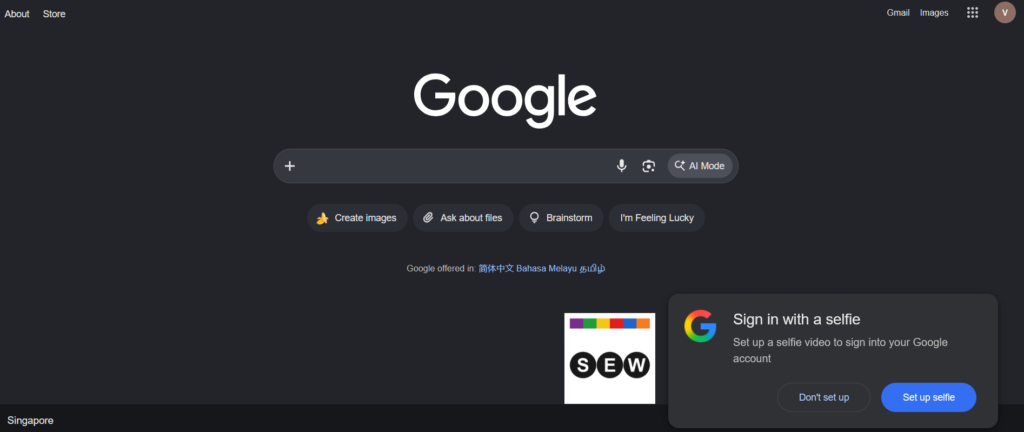
Google is promoting its selfie video sign-in option directly on the Google homepage. A new nudge asks users to set up a selfie video that can later help them sign in to their Google Account.

Google announced selfie video sign-in in July as an additional way for users to access their accounts if they cannot use their usual sign-in method. Users record a short video of their face from different angles, which Google can later compare with another selfie video to help verify their identity.

The option is not available for every Google Account or in every region. Eligible users can set it up from the Security & sign-in section of their Google Account, according to Google’s Help documentation.

The homepage nudge shows a “Sign in with a selfie” card that says, “Set up a selfie video to sign into your Google account,” and offers “Don’t set up” and “Set up selfie” buttons.

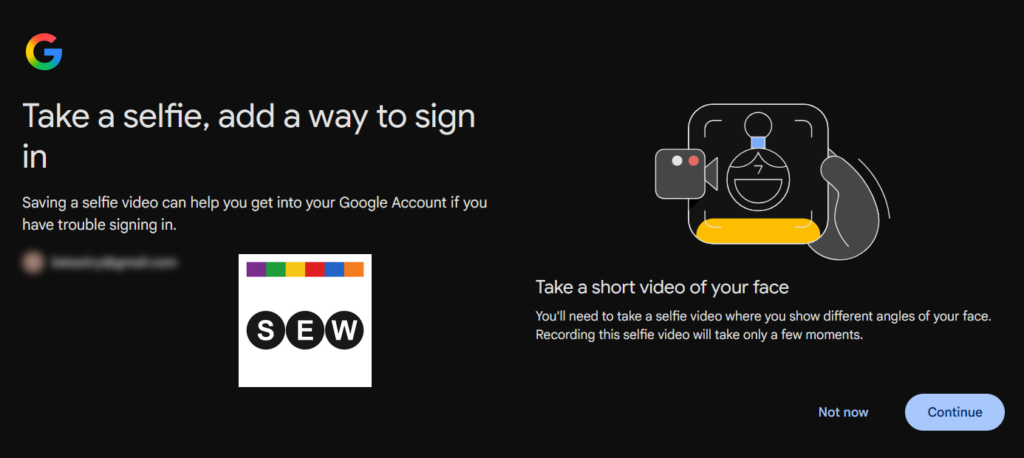
Clicking Set up selfie opens a screen titled “Take a selfie, add a way to sign in.” It asks users to record a short video of their face from different angles.

Image Credit: Venkat | Search Engine Watch

This introductory screen differs from the one users see when they follow the setup path through their Google Account settings, which says “Protect your account access with a selfie.” The flow then leads to the same consent screen.


Image Credit: Venkat | Search Engine Watch

That screen explains that Google may review the video with a model to determine whether the person is real and old enough to use certain Google services. It also offers an optional “Improve Google services” setting, which allows Google to use the selfie video and related data to improve facial recognition, age estimation, and other verification methods. Google’s Help page

The homepage nudge provides another entry point to Google’s selfie video sign-in setup, although it is unclear how broadly Google is showing it.

The post Google nudges users on its homepage to set up selfie video sign-in appeared first on Search Engine Watch.

Source:: searchenginewatch.com

Profound raises $180 million to move beyond AI search tracking, reaches $1.8B valuation

Profound has raised $180 million in a Series D funding round co-led by Sequoia Capital and Kleiner Perkins, valuing the marketing software company at $1.8 billion. Announced on September 15, the investment will support its expansion into software that helps marketing teams research, produce content and manage campaigns.

The company says it now serves more than 1,000 enterprise brands, including Comcast, Walmart and The Estée Lauder Companies. It also told TechCrunch that revenue tripled over the past six months. Those are company-reported figures; the funding announcement does not disclose an absolute revenue number.

The round comes less than seven months after Profound announced a $96 million investment at a $1 billion valuation on February 24. It was already developing marketing agents then, making today’s financing an acceleration of that strategy rather than a sudden departure from search analytics.

Profound wants to create the campaign, too

Profound’s search tools show businesses how their brands appear in answers from services such as ChatGPT, Gemini and Perplexity. They track mentions, sentiment and cited sources, running selected prompts repeatedly to monitor changes. That gives marketers a way to investigate, for example, why an AI assistant recommends a competitor or describes their product incorrectly.

Its AI Marketer takes those findings further by identifying opportunities, proposing projects and assigning tasks to software agents. A separate Context Manager draws on company documents, meeting transcripts and internal communications to inform the work.

Advertising is also part of the expansion. Profound says its Ads Studio workflow supports creating, editing and launching campaigns through OpenAI, Google and Meta’s ad managers, with tracking through its own pixel. The company first announced Ads Studio in an invite-only beta on July 7, so the funding should not be mistaken for the product’s launch.

The commercial implication is that Profound can sell into content production and campaign management budgets alongside the money companies allocate to monitoring AI search. Its valuation now accompanies a considerably broader product than a dashboard of brand mentions.

AI referrals already produce measurable revenue

It would be misleading to suggest that Profound customers have no way to connect AI traffic with sales. The company introduced a Google Analytics integration in April 2025 that links AI-originating visits to recorded revenue events. Where the visit and conversion are captured, marketers can see purchases associated with that referral source.

There are customer claims beyond visibility scores, too. A Profound-published case study says skincare company Omnilux’s AI-attributed revenue grew from roughly 1% to 3% of total revenue during its work with the platform. That is a change in revenue share, not evidence that the company’s overall sales tripled. It is also a vendor-published account, rather than an independent test of Profound’s contribution.

Profound’s own research illustrates the remaining difficulty. A July study of more than two million AI conversations and associated browsing activity reported increased brand-site visits after AI assistants mentioned those brands. Its methodology explicitly acknowledges that it did not measure purchases, was not a randomized experiment and could not fully eliminate selection bias.

A retailer could receive more sales from AI referrals as customers increasingly use those services, without every increase being attributable to its optimization work. Establishing the contribution of a tool or campaign requires a credible estimate of what would have happened without it. That is the distinction controlled conversion-lift experiments are designed to examine.

The budget pitch is getting broader

A revealing product announcement arrived a day before the funding. On September 14, Profound introduced Command Center, which reports agent usage and estimated hours saved across a marketing team. Its time-saving calculations use default assumptions about how long work takes, and customers can edit those assumptions.

That gives Profound another route to justifying its subscription. A company may struggle to isolate the sales contribution of appearing in more AI answers while still finding value in producing a usable report or campaign at a lower cost.

The calculation deserves scrutiny, though. An estimate based on completed agent runs needs to account for the time people spend checking, correcting and approving the output. Buyers should compare the cost of finished work against their previous process before treating a dashboard’s “hours saved” figure as a saving.

This broader product also makes Profound’s growth harder to interpret as evidence for a standalone AI-search visibility category. Its published figures do not separate demand for monitoring from demand for content, automation or advertising tools.

For marketers evaluating the platform, that distinction affects what a successful purchase looks like. A visibility-monitoring contract should be judged on the coverage and decisions it improves. A production tool should earn its fee through usable work and demonstrable savings. Where the promise is additional sales, the evaluation needs to account for sales that would have happened anyway.

The post Profound raises $180 million to move beyond AI search tracking, reaches $1.8B valuation appeared first on Search Engine Watch.

Source:: searchenginewatch.com

Google makes publisher ad load visible in Chrome’s real-user data

Google’s experimental CrUX metrics use real Chrome sessions to report visible ads, viewport share, CPU time and network bytes, but they do not yet include a pass/fail standard.

Google has added four advertising metrics to the Chrome User Experience Report (CrUX), giving publishers, advertisers and ad-tech companies a public field-data view of the advertising load experienced by Chrome users.

The announcement says the metrics are designed to help the advertising industry evaluate ad opportunities and make product decisions. They cover the number of ads users see, how much of the visible page those ads occupy, and the browser resources used to deliver them.

Google adds four field measures for advertising

Metric What Chrome measures
Ad Count The average number of ad frames visible in the viewport during a session.
Ad Density The average percentage of the viewport occupied by ads.
Ad Weight: CPU The cumulative CPU execution time used by ad frames and workers.
Ad Weight: Network The cumulative kilobytes transferred by ad frames and ad resources.

The measurements are reported at the 75th percentile. A reported Ad Density of 23%, for example, means 75% of reported sessions had a density of 23% or lower; the remaining 25% experienced a higher value.

Google says the metrics are not Core Web Vitals and do not have “Good,” “Needs improvement” or “Poor” thresholds. They are labelled experimental while Chrome collects feedback and considers changes.

Chrome identifies ads before it measures them

Chrome’s system classifies advertising at the browser level. It checks subresource and iframe requests against a condensed version of the EasyList filter rules, then analyses the JavaScript stack when scripts create additional resources or frames. Resources inside an iframe already classified as advertising inherit that label.

Chrome is measuring resources and frames it identifies as ad-related; it is not judging whether a creative is useful, relevant or annoying.

The ad-detection documentation says developers can inspect the result in Chrome DevTools. The Application panel can highlight detected ads and show local measurements, while the Network panel can expose an “Is ad-related” column for individual requests.

The public report has an ads.txt condition

The aggregate CrUX metrics are not available for every website. Google’s measurement methodology says Chrome includes only origins with an ads.txt file containing at least one authorized seller. Sites without ads.txt, or with only a placeholder record, are excluded from CrUX ad-metric reporting.

DevTools can still show local ad measurements for a page without an eligible ads.txt file, but those figures will not appear in the public CrUX aggregates.

Google says the metrics are available in CrUX now, with coverage expected to increase over the next month. The tooling guide lists CrUX Vis, the CrUX API, the History API and Chrome DevTools as the initial access points. BigQuery support is still being developed.

The data can expose heavy ads without deciding what “heavy” means

The first version is useful because it separates problems often bundled together as “too many ads.” A page can have a high visible ad count, a large ad-covered viewport, expensive ad scripts or a large network payload. The four measurements let publishers see which cost changes after a template or monetization update.

Google has not published a standard for interpreting the result. There is no threshold for acceptable ad density, no Core Web Vitals-style status and no stated ranking effect. Advertisers can use the data as another media-quality signal, while publishers can compare templates and monitor regressions. A p75 number alone does not establish better attention, conversion, revenue or search performance.

The post Google makes publisher ad load visible in Chrome’s real-user data appeared first on Search Engine Watch.

Source:: searchenginewatch.com