Kategorie-Archiv: SEO

Google may bin your Business Profile post over a phone number

Google has revised its Business Profile posts policy to warn that it may remove posts containing unverified phone numbers, email addresses or social media handles. Its posting guide also says a phone number in a post description may trigger rejection if Google cannot verify its connection to the business.

Hiroko Imai spotted the documentation changes, which Search Engine Roundtable reported. The pages establish Google’s current rules, but give no date for when enforcement changed.

Google has rewritten its phone-number rule

The previous policy explicitly prohibited phone numbers in post content. That wording appears in an August 31 snapshot of Google’s help page.

The current policy focuses on whether contact information is verified and extends the warning to emails and social handles. Google’s posting guide makes the phone-number condition more explicit: Google must be able to connect the number to the business where the post appears.

Neither page explains how Google verifies an email address or social handle included in post text.

The Call now button avoids that uncertainty

The revised wording gives business owners more room to include a legitimate phone number than the old blanket prohibition did. However, approval depends on Google’s ability to establish the connection, and the documentation supplies no procedure for obtaining that approval.

For posts intended to generate calls, Google’s recommended Call now button remains the clearest documented option. It uses the verified phone number attached to the Business Profile. For bookings or orders, the posting guide allows an action button linking to a website where customers can complete the task.

If a post is rejected, Google’s guide says it will be hidden from Search and Maps. Owners can inspect the question mark beside its Not approved status to identify the policy involved, then edit the post.

The post Google may bin your Business Profile post over a phone number appeared first on Search Engine Watch.

Source:: searchenginewatch.com
Gemini gets Photoshop tools without asking you to upgrade

Adobe has begun rolling out tools from Photoshop, Lightroom, Adobe Express and Firefly inside Google Gemini, with access across all Gemini plans. The integration lets users request photo edits and create marketing assets through the chatbot.

The rollout started on September 24. Adobe’s setup documentation says users need an Adobe account, which can be created for free, and that the feature currently supports English only.

Product photos and campaign assets, through chat

According to Adobe’s help page, users can upload several product photos and request consistent lighting, color and cropping across the batch. They can also adapt an existing asset for different social platforms or customize an Express template with their own text and imagery.

Adobe’s product page describes applying Lightroom presets to batches of photos and using uploaded logos to create branded product mockups.

To connect the tools, enable Adobe in Gemini’s connected apps, sign in, then type @Adobe in the prompt bar. Adobe describes global availability, except in regions restricted by its trade compliance rules.

There is an inconsistency in the account instructions: the product page says users can start without an Adobe account, while the help page explicitly requires one. Following the documented setup means signing in. The pages reviewed also leave numerical usage allowances unspecified.

Adobe also adds PDF editing to Claude

In the same announcement, Adobe added Acrobat to its Claude plugin, which it says now includes more than 80 tools. Users can organize and redact PDFs, with an interactive editor for text changes and annotations. A separate editor lets users change individual elements in Express designs.

Batch editing is the useful part for small marketing teams

The practical addition is being able to submit several existing assets and request the same treatment across them. For a shop preparing a product catalog, consistent cropping and lighting address a recurring production task. Adobe’s documented workflow also carries that material into social variations, bringing photo preparation and campaign design into the same conversation.

The announcement gives small teams a reason to try that workflow on their existing Gemini plan. Its value for regular production will depend on the available allowance and the quality of the exported files, which SEW has not tested.

The post Gemini gets Photoshop tools without asking you to upgrade appeared first on Search Engine Watch.

Source:: searchenginewatch.com

Claude’s growth comes with a $7.3 billion computing bill

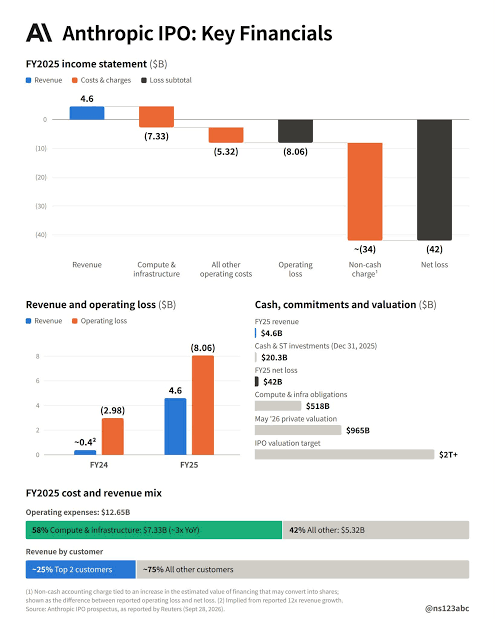
Anthropic’s IPO prospectus gives a clearer picture of the cost of building and running Claude as the AI company prepares for a potential public listing. The company reported nearly $4.6 billion in revenue in 2025, up roughly twelvefold from the previous year. But it also reported a net loss of nearly $42 billion.

The two figures need some context. Reuters reports that roughly $34 billion of the net loss came from an accounting charge related to financing that could eventually be converted into Anthropic shares. That charge was not money Anthropic spent operating Claude.

What the $42 billion loss actually contains

Anthropic’s prospectus shows that computing and infrastructure have become a major part of the company’s operating costs. The company spent about $7.33 billion on compute and infrastructure in 2025, according to Reuters. That was more than half of its $12.65 billion in total operating expenses and roughly three times its spending in 2024. Its operating loss was $8.06 billion, compared with $2.98 billion the previous year.

This is an important distinction when reading the $42 billion headline loss. The reported net loss includes the roughly $34 billion accounting charge, while the operating loss reflects the cost of running the business before that separate accounting item.

A simple way to see the difference is to compare the figures: $42 billion minus roughly $34 billion is about $8 billion, broadly in line with the reported $8.06 billion operating loss. That does not turn the calculation into a cash-flow measure, but it shows why the $42 billion headline should not be interpreted as $42 billion spent on Claude.

Anthropic has also been securing additional computing capacity. In April, the company announced an agreement with Amazon for up to 5 gigawatts of additional capacity and said it would commit more than $100 billion over 10 years to AWS technologies.

Revenue is growing with Claude usage

The revenue figure also tells a more specific story about Anthropic’s business. Reuters reports that about $3.8 billion of Anthropic’s 2025 revenue came from customers paying according to their use of Claude, while subscription revenue was $789 million. That means usage-based Claude revenue accounted for roughly 83% of the company’s total revenue for the year. Anthropic said it expects consumption-based revenue to remain the substantial majority of its revenue for the foreseeable future.

That makes the relationship between Claude usage and infrastructure particularly important. As customers use the models more, Anthropic can generate more usage-based revenue, while the company also needs computing capacity to serve that demand.

Anthropic has described the scale of that infrastructure in its own announcements. The company says it uses more than one million Trainium2 chips to train and serve Claude and is expanding its computing capacity across AWS, Google Cloud and Microsoft Azure.

The infrastructure commitments are much larger

The prospectus also shows that Anthropic’s future infrastructure requirements extend well beyond its 2025 spending. Reuters reports that Anthropic plans to spend $518 billion on cloud, computing and infrastructure obligations in coming years. That is a future commitment figure, not an amount the company spent in 2025.

A separate Reuters report says Anthropic had $54.6 billion in non-cancellable hosting and computing commitments at the end of 2025, while its total long-term commitments exceeded $417 billion by early 2026, covering 3.5 gigawatts of dedicated computing capacity.

Those figures should not be collapsed into a single measure of current spending. An income statement records expenses incurred during a reporting period, while contractual commitments describe obligations extending into the future.

The post Claude’s growth comes with a $7.3 billion computing bill appeared first on Search Engine Watch.

Source:: searchenginewatch.com

Claude hits 950 million monthly visits, with barely any paid traffic

Claude.ai reached an estimated 950 million visits in August 2026, up 540% year on year, according to Similarweb’s new analysis. Paid channels accounted for just 0.46% of visits that month, compared with 3.5% at ChatGPT and 6.8% at Gemini.

The report tracks worldwide desktop and mobile web traffic alongside app usage. Its web estimates cover visits, including repeat use, rather than individual people or paying subscribers.

Searchers already know Claude’s name

Similarweb classified 97.9% of August’s search clicks to Claude as branded. Across July and August, direct traffic supplied 73.6% of website visits, with organic search contributing 12.3%.

That gives search marketers a more specific reading of the growth: search is largely helping users reach a product they already know. The keyword figures offer little evidence of Claude acquiring its audience through broad, non-branded searches.

The expansion also slowed. Monthly web visits have stayed near 950 million since May, although unique visitors and app usage continued to reach new highs.

The Super Bowl complicates the attribution

The small paid-channel share leaves the influence of offline advertising unresolved. Similarweb links Anthropic’s February Super Bowl campaign with increases in app activity and sign-up-page visits. Anthropic also acknowledges running advertising campaigns.

Someone who sees a television ad and later searches for Claude can arrive through organic search. A returning user can then generate dozens of direct visits. Both routes increase the unpaid share while the advertising that first introduced the product sits outside that web attribution.

For marketers, the useful finding is that Claude has built substantial demand by name and repeat usage. Calculating how cheaply it acquired that audience would require campaign spending and acquisition data beyond this traffic report.

The post Claude hits 950 million monthly visits, with barely any paid traffic appeared first on Search Engine Watch.

Source:: searchenginewatch.com

Bing tests new format highlighting top ad and organic results

Bing tests new format highlighting top ad and organic results

Bing appears to be testing a new format that gives added visibility to both ads and organic results. In this test, Bing shows website logos below the search bar the first logo representing the top-ranking ad, followed by two more logos representing the websites ranking in the first and second organic positions for that same keyword.

Previously, we saw Bing doing something similar using only organic results. Now, it looks like Bing is picking one logo from the ad and two from the organic results, combining them together.

Here is a screenshot of this behavior.

Bing tests new format highlighting top ad and organic results

Bing tests new format highlighting top ad and organic results Bing tests new format highlighting top ad and organic results

This is a feature I personally like, since it gives added visibility to both organic and ad results at once, within a single, compact format.

The post Bing tests new format highlighting top ad and organic results appeared first on Search Engine Watch.

Source:: searchenginewatch.com